

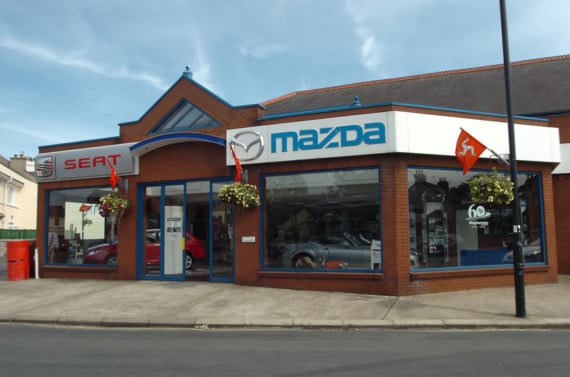
The liquidator of a collapsed motors business has denied former customers are being pursued unfairly over debts they say are not owed.
In excess of 500 letters have been sent out to those suspected of owing money to Raymotors. Well over £100,000 of debt has been recovered so far.
The long-established family firm in Ramsey closed in 2017, with the loss of 28 jobs, when a liquidator was appointed by the court.
An irretrievable breakdown in the relationship between the two directors, brother and sister David Casement and Christine Radcliffe, was blamed for a deadlock in Raymotors’ management.



Tax returns and the financial accounts going back to 2012 were outstanding, Treasury was threatening prosecution and Raymotors failed Volkswagen and Seat audits.
Letters sent out by the court-appointed liquidator Paul Shimmin to those suspected of being debtors warn: ’It is my obligation under my appointment to recover these monies from you.
’In the event that payment is not forthcoming I reserve the right to take legal action against you to recover these funds or appoint a debt collection agency.’
One former customer contacted the Manx Independent after she was sent a demand by the liquidator for £1,966.54 for work done by Raymotors between six and 11 years ago.
She said: ’On each occasion I had work done to my car I paid the invoice at the Raymotors desk before collecting the keys.
’I am guessing I am not the only customer of Raymotors to have received a letter from the liquidator demanding payment of a debt I do not owe.’
She said the liquidator could have no evidence at all that she owed anything and was concerned vulnerable people would be intimidated into paying up even if they are not debtors.
Mr Shimmin denied the letters were threatening.
But he said he had a duty as liquidator to recover the company’s assets, including debts owed.
He accepted that the state of the company’s records caused difficulties.
Mr Shimmin said: ’The records are not 100% complete. There is nothing definitive showing this is absolutely everything that’s owed. We can only do what we can with the company’s records.’
The 500 letters sent out, in four tranches, since the company went into liquidation cover suspected unpaid invoices for everything from vehicle purchases, to repairs and replacement keys.
Mr Shimmin said: ’We’ve got to take a diplomatic approach. But we are aware of bills not being paid.
’There is a lot of evidence that vehicles have gone out where invoices have not been paid.
’If you have evidence that suggests there might be a debt then you take steps to prove that debt is outstanding.’
Mr Shimmin urged anyone who receives a letter but believes they have paid their invoices to provide evidence of that payment.
But he accepted that not everyone keeps records dating back a decade or so.
He said: ’If a debt is due we will look at what evidence there is. If it is argued that it is not due we will listen.
’A lot of people have come back with an explanation and we are more than happy to accept those explanations. But I still have a duty to investigate.
’We’ve had a few who have said "this can’t be right". One or two have said they really don’t know but it is possible.’
He said explanations would be looked at case by case.
He said that half a dozen people had not liked the tone of his letter but he believed it to be a fair mix of his complying with his duty and only recovering debts that are due.
From a legal point of view, even if a company’s debts are the result of its own shortcomings regarding its record keeping, then those debts are payable if it can be proved they are due.
But he added: ’You can’t sue people if you don’t have sufficient evidence.’
He said the company had a significant amount of debt on its books, well in excess of £300,000. Raymotors was not insolvent when it was put into liquidation.
Mr Shimmin said the liquidation has seen vehicles sold, well over £100,000 of debts collected so far and creditors confirmed.
He said there was substantial interest in properties that the company owned but did not use in its day-to-day trade.
But he said the company itself could not be sold as a going concern.
Comments
This article has no comments yet. Be the first to leave a comment.