
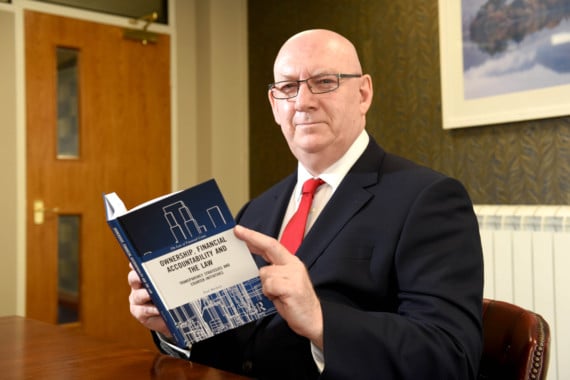
Senior advocate Paul Beckett says all is not what it might seem with plans to create a public beneficial ownership register.
The law expert talked of ’loopholes the size of Spaghetti Junction.’
He spoke out after the Isle of Man government announced it was intending to comply with the provisions of the EU fifth money laundering directive by permitting public access to details of the beneficial owners of companies.
The commitment announced by the island, jointly with Guernsey and Jersey, is aimed at increasing ’further transparency and accessibility while maintaining high standards of accurate, up-to-date, verified information’.


.png?width=209&height=140&crop=209:145,smart&quality=75)

During Prime Minister’s Questions Theresa May said she was ’very pleased’ with the announcement made by the Isle of Man, Jersey and Guernsey.
And the American FBI had earlier, before the announcement had been made, praised the island for the ’immense value’ of the island’s work on beneficial ownership.
But island-based Mr Beckett told Business News: ’All’s not what it appears. It’s not the full story and I’m merely stating facts.’
And he said the of the joint statement issued by the Isle of Man, Jersey and Guernsey: ’This will neither be as straightforward nor as comprehensive as may appear at first sight.’
The MannBenham based senior advocate said the publication of his latest book could not have been more timely.
The 280-page book is called Ownership, Financial Accountability and the Law.
It is published by Routledge which specialises in serving scholars, instructors, and professional communities worldwide.
Talking from his office in Victoria Street, Douglas, Mr Beckett stressed his words on the issues are purely based on facts and he is not out to make any political statements or comment.
Mr Beckett counts himself as a supporter of the island, and has previously written an article for the Examiner on why he believes the island is not a tax haven
He said that according to the Financial Action Task Force, (FATF), a registrable beneficial owner is someone who owns or controls 25% or more of a company.
He said this threshold has been adopted Europe-wide, including the Crown Dependencies, and is found in the Beneficial Ownership Act 2017 of the Isle of Man.
He said: ’Anyone owning 24.99% or less will not be required to register.
’Any company with five owners - if each holds under 25% - will be entirely off the radar.’ He told Business News: ’We are no different from anybody else in this at all, we are not better or worse, we are exactly the same as all the other regulated jurisdictions.’
In the book he says organisations such as the OECD and the European Union adopted the FATF recommendations ’unquestionably, as if they were a gold standard’.
He recommends in the new book that FATF should undertake an impact assessment of its methodology and he warns: ’Weak links in chains do not come much weaker than this.’
His second point is that he believes the idea of ’ownership’ is being manipulated.
In his book he writes: ’Constructing a regulatory system on ownership is to build on sand.’
He adds that ownership is a complex, multi-layered and shape-fitting concept, which only grudgingly lends itself to deconstruction. Beneficial ownership on closer examination proves incapable of exact legal definition.’
Mr Beckett believes the idea of ’ownership’ is being manipulated.
’What if there is in fact no owner, and so no-one to be registered in the first place.
’Various offshore jurisdictions have introduced laws which in effect allow a company to be owned by no-one at all - counterintuitive thought that seems.
’This is the global industry in ’’beneficial ownership avoidance’’ through the use of so-called ’’orphan structures’’.
’Where there is no ownership, there is no accountability.’ Business News asked whether this means there are still loopholes over the issue of beneficial ownership. He replied: ’Huge, loopholes the size of Spaghetti Junction. Enormous loopholes and what my book asks at the end is ’’why?’’
’Because it takes five minutes to explain that these loopholes exist.
’Why are they there?’
’Is there really a genuine political will in Europe to close these loopholes or are they comfortable with the way it is?.
’I would stress that the Isle of Man is following world standards.
’I’ve said this many a time before but the Isle of Man does not share the characteristics of a contemporary tax haven.
’If you look at what a tax haven is, these days it is not primarily about tax it is about concealment, it’s about strange forms of companies.’
He pointed to the island leading the field in fraud prevention through the 1736 law, the Fraudulent Transfers Act which is still actively referred to to this day.
(Gravelly Hill Interchange, better known throughout the British Isles by its nickname Spaghetti Junction, is junction 6 of the M6 motorway where it meets the A38 Aston Expressway in the Gravelly Hill area of Birmingham.)
Meanwhile, an island accountant has told Business News there is a ’danger’ that some companies such as corporate service providers in the island might consider their futures here after last week’s announcement which is is predicted to bring a fully public beneficial register by 2023.
Phillip Dearden said he believed there would now be an ’incremental sigh’ over the proposals, from companies such as corporate service providers.
He said last week’s unexpected announcement from the Isle of Man, Jersey and Guernsey was in some ways ’inevitable’ given the changes in the regulatory landscape over the last few years.
He said of the announcement: ’It’s not good for the island but it is not a disaster.’
He believed there woul d be ’little gain’ from the measure.
He believes that at the end of the day it will mean higher costs being incurred on the clients of firms such as CSPs.
He added that all the changes introduced in the last 20 years or so in terms of following regulatory demands have had added costs which would inevitably get higher with this announcement.
Phrases such as governance and transparency were ’buzz words’.
Asked by Business News if there was a risk of firms such as CSPs leaving he admitted ’there is a danger’ of that but he does not believe it to be enormous
Comments
This article has no comments yet. Be the first to leave a comment.