
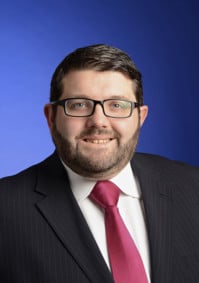
Mark Essex, director of public policy at KPMG and an esteemed expert on Brexit, is tomorrow (Wednesday) due to lead a Brexit Forum for local business. Business News caught up with him ahead of the event
A man in great demand, Mark is currently in shuttle mode with a diary full of appointments to speak on Brexit and its implications for UK businesses.
His visit to the Isle of Man comes after UK Prime Minister Theresa May’s much anticipated Florence speech and the output of the UK political party conference season, so it is a timely update for local businesses wanting to understand the potential impacts Brexit will have for their future prospects.
Unlike others in his field, Mark was unsurprised at the referendum result.
.jpeg?width=209&height=140&crop=209:145,smart&quality=75)
.jpeg?width=209&height=140&crop=209:145,smart&quality=75)
.jpeg?width=209&height=140&crop=209:145,smart&quality=75)
Having studied the Brexit arguments since 2014, he had predicted the result would go to Leave with between 51 per cent and 53 per cent. This was uncannily accurate to the 51.89 per cent vote actually recorded.
Since then he has led an intelligence and analysis team researching the consequences of the Vote Leave on KPMG clients.
’With the invocation of Article 50 and the return of Theresa May in June to lead the Government, albeit with a reduced majority, attention has now turned to the process of leaving,’ says Mark.
’There are three stages to this - the divorce, a new deal and the possibility of transition.
’At the moment current negotiations are centred on the divorce element and in particular the cost of parting company, citizens’ rights and issues around the Irish/UK border.
’While these are significant, more concerning to businesses is what the new deal will look like.’
With a number of models being mooted, there seems little political agreement over what the final version will be. The risk that is that if this cannot be agreed, the cliff-edge of ’no deal’ and the World Trade Organisation (WTO) option will come into play.
’Meanwhile,’ says Mark, ’in the current uncertainty firms are in the unenviable position of having to make costly and irreversible decisions in order to maintain their service to customers and stakeholders.
’The UK must seek to convince the EU that adopting an inflexible stance will inevitably lead to a bigger loss than that which the continent has already suffered, having lost its second biggest economy and second biggest contributor.’
If Ms May’s recent speech in Florence was meant to calm nerves, it was only partly successful says Mark:
’The speech was given in a different tone, which is helpful.
’The acknowledgement of a transition period is welcomed by business but I have always worked on the basis that there would be a transition of around two years.
’However if there is no deal, there is no transition. So the cliff edge remains a possibility prudent businesses must plan for.
’Therefore, for all the position papers, and the Florence speech, the fundamentals of our advice haven’t changed.
’If anything I am more pessimistic.
’The game theory of all this is that if it becomes clear that Europe cannot do a bespoke deal then the UK’s best option is to walk away completely and give business a year’s notice to plan for WTO arrangements.
’That scenario is trending more likely in my game theory analysis.
’This could all change with a breakthrough from EU negotiator Barnier’s team, though. It’s a very fluid environment!’
You can hear more from Mark at the KPMG Brexit Forum tomorrow morning (Wednesday) at the Palace Hotel, Douglas, where he will be joined by Professor St John Bates who will explore Brexit from an Isle of Man perspective and Paul Cawley from KPMG in the Isle of Man who will talk on VAT and Duty.
There will also be a panel session including Mark Essex, Professor St John Bates, Sandra Skuszka, Head of VAT, KPMG Isle of Man and Carl Hawker, Deputy Chief Executive of the Department for Enterprise. For information on attending the event contact: [email protected]
Comments
This article has no comments yet. Be the first to leave a comment.