

Putting too much personal and potentially sensitive information on social media could be damaging for businesses, it has been claimed.
Former police officer Colin Tansley said: ’Don’t make it easy for the criminals to get your data.’
He added it could be as simple as putting an exact date of birth on one of the social media websites.
Mr Tansley, a former police officer in the UK is now managing director of Intelect, a cyber security and investigations company in the island.
.jpeg?width=209&height=140&crop=209:145,smart&quality=75)



He said: ’My background is in policing investigations and I spent years chasing criminals. But there are many ways you can be attacked from a cyber point of view.
’As an investigator I now spend a lot of my time on online investigations. You won’t be surprised at all to hear that it is dead easy to find out stuff. I don’t need to leave the office and I don’t need to be knocking on doors or chasing people about like I used to a few years ago.
’Many of us live our lives online.’
He was speaking to an audience of business people at the Cyberisle gathering at the Villa Marina, Douglas.
He said that many business people were involved in some forms of social media because they felt they needed to be involved on these platforms.
But Mr Tansley warned the internet is a ’target rich environment’ for the cyber criminals and there are a lot of vulnerable companies.
He said offenders were ’opportunists, manipulative, greedy and they are adaptable
’And that is what they are doing with the internet - they use it as their playground.
’There are so many victims out there and the offenders are adapting to it all the time.’
He said if you step away from the fanciful terminology it is basically all about scams and conning.
He said it is similar to crimes where people knock on the doors of elderly people and try to con their way into their homes and then ’rob them blind’.
’It is done on the internet but it is anonymised.’
He used the example of an unnamed business and a director of that firm.
He said what he found was ’typical of many companies in an offshore environment’.
He said that in the space of five minutes he found lots of pictures, a personal email address, telephone number, details of a spouse, when they got married, and access to the network of a friend.
’From that I was able to identify the company accountant. That would give the criminal another potential target, the person in charge of finances, the senior administrator and the client service manager, and off the criminal goes, getting information about those people.’
He warned against people leaving personal information ’lying around’ on social media.
He likened it to leaving valuables on show.
He asked the audience: ’Would you leave your credit card lying around anywhere? Do you leave stuff in the car?
’It’s not so much an issue here but if you went to Liverpool, Manchester or Leeds would you leave your phone on the dashboard on the car seat?’
Mr Tansley said: ’You have to start thinking about identity theft.’
He said: ’All this personal and corporate information strung together makes a powerful profile. It is so easy to set up fake and clone accounts online.
He said it was about the criminals making us believe what we see.
’Many people trust the internet, but we are going to have to take a step back and start questioning what we see.’
He explained he worked in the North East of England and as part of his work he investigated a spate of distraction thefts from people’s homes.
’We used to say: ’’Lock your doors.’’ Well we are now saying: ’’Lock your digital doors.’’
’We are talking about crime so start thinking about these things.’
He said that when he visits companies he urges them not to leave too much personal information on the company website.
’The times I see things such as: ’’This is Jenny, she works as the company accountant, she supports the local rugby team, she has three dogs’’ and there is too much information which can be a gift for criminals.’
He added: ’If a burglar sees a house with security lights and alarms, and next door a house with no security and the windows open - where is the burglar going to go. It’s a no-brainer.
’They are opportunists so we are going to have to make life as difficult as we can for them.’
He said he often sees on social media people advertising their date of birth and said: ’What’s the first security check when you ring the bank? We are gifting them (the criminals) with sensitive stuff.
’It’s about questioning and not trusting.’
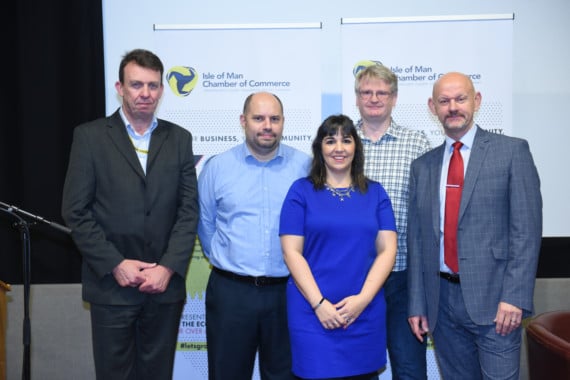
Mr Tansley joined a panel of speakers at the event that was called: ’Data Breaches, The Silent Threat to your Business.’ With Mr Tansley were Lee Williamson, senior technical consultant, Skanco, Mark Stringer, owner of Eniac Solutions, and Jeff Ames, chief technology officer at Computer Network Defence.
Comments
This article has no comments yet. Be the first to leave a comment.