
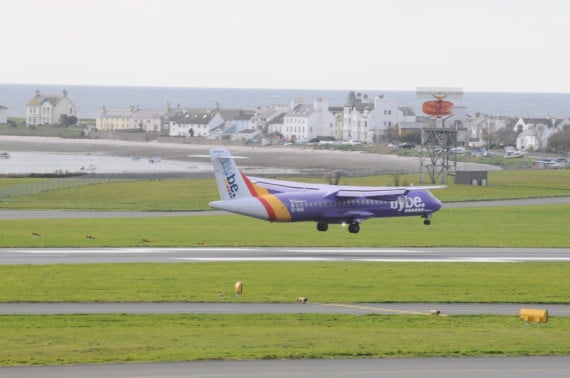
Flybe’s owners are again seeking government support while a rival airline chief has accused ministers of being ’blind sided by billionaires’.
The troubled regional airline is owned by Connect Airways, a consortium made up of Virgin Atlantic, Stobart Air and hedge fund Cyprus Capital which formally took over the last year, with the consortium also providing loans to Flybe.
This week, it has been reported in the UK that Flybe is seeking to borrow £100m from the UK government.
The airline’s boss, Mark Anderson, has said it would not be a bailout.
.jpeg?width=209&height=140&crop=209:145,smart&quality=75)


The airline covers regional airports that other airlines don’t and has routes from the Isle of Man to Birmingham, Manchester and Liverpool.
Only the latter is served by another airline, EasyJet.
If Flybe’s plea for a loan succeeds, it will be an unusual move by the government, which declined to assist Thomas Cook when it asked for a loan before the tour operator collapsed in September 2019.
Flybe has been struggling under the weight of a £10 million bill for air passenger duty as well as a slowdown in demand that has hurt the airline’s finances.
It is the largest carrier to fly out of some regional airports, like Newquay.
However, while Chancellor Sajid Javid is believed to be in discussions over how to rescue the airline, the move has been savaged by Ryanair Group chief executive Michael O’Leary .
British Airways’ owner IAG has also filed a complaint to the EU arguing that Flybe’s rescue breaches state aid rules and EasyJet has said taxpayer funds should not be used to save the airline.
In his open letter to Mr Javid that was printed in the Financial Times, Mr O’Leary said the carrier was ’doomed to fail’ and argued its owners should be footing the bill to ’bail out the loss-making Flybe’.
He added: ’Clearly your government is being blind sided by these billionaires.
’If Richard Branson and his mates won’t lend £100m to Flybe, then why should the hard-pressed British taxpayer rescue them?’
Disputing that Flybe is a viable business, Mr O’Leary said in his letter that Flybe has a business model based on ’carrying a small number of passengers, at very high fares, on half-empty turboprop aircraft’.
Mr O’Leary added: ’It is a business that has lurched from failure to failure over the last 20 years, having been restructured numerous times as British European, BA Regional and later Flybe in multiple different guises.
’What Flybe consistently does is lose money because it has a failed business mode.’
The FT also reported that Flybe has said its agreement with the government is not a bailout but a short-term payment plan for a debt of less than £10m, rather than a year-long air passenger duty bill that would likely amount to about £106m.
Comments
This article has no comments yet. Be the first to leave a comment.