
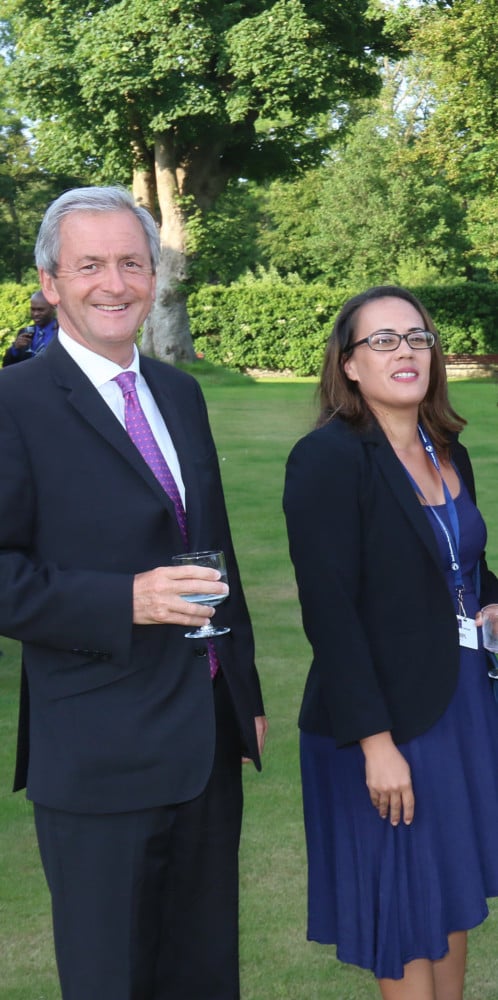
The island has hosted the ninth Small Countries Financial Management Programme.
Twenty-four senior government officials, representing central banks, regulatory bodies and ministries of finance from 20 small, developing countries, completed the first part of their intensive two-week programme on the island, first at the Nunnery and then at the Fort Anne.
This year there were 11 participants from the Caribbean, six from East Asia and the Pacific and seven from Africa and the Indian Ocean.
Executive director Mark Shimmin explained: ’The programme aims to improve the management of the financial sector and financial management in small developing countries, to positively impact growth and poverty reduction, to improve their capacity to respond to ever increasing international standards and regulation and to enhance the leadership, strategic management and negotiation skills of the participants, so that they can both apply these effectively and engage and inspire others to follow their lead.’
.jpeg?width=209&height=140&crop=209:145,smart&quality=75)
.jpeg?width=209&height=140&crop=209:145,smart&quality=75)
.jpeg?width=209&height=140&crop=209:145,smart&quality=75)
Tuesday evening saw the participants welcomed to Government House by Lieutenant Governor Sir Richard and Lady Gozney.
Sir Richard told his guests that his previous experiences had given him ’a sense of the challenges you face’.
He said: ’The international agencies and organisations, not to mention public opinion in your countries, are demanding and expect much from those monitoring the public purse in small countries such as yours.
’You have to work within your own internal politics, meeting politicians’ exacting demands. You have to balance good, strong regulation with economic growth. You are the financial consciences of your countries.’
Morven Williams is director of international bank and trust corporations at the Antigua and Barbuda Financial Services Regulatory Commission.
He commented on the similarities between their financial sector and that in the island.
He said: ’Our financial sector is dominated by international offshore banks as well as gaming companies.
’One of the things we have done, which is consistent with what would have been done in the Isle of Man, is to ensure our jurisdictions remain compliant with the standards of the international community.
’The stark difference is that, while the Isle of Man would have witnessed growth in this sector in recent years, our sector would have done the opposite. It has plummeted and it’s basically due to the challenges of the international community that have affected our sector significantly.’
Cheryl McCarthy is deputy commissioner of the Financial Services Commission in the Cook Islands, which has a population of just 14,000 to 15,000.
She said that the majority of their business comes from the US.
’About 90 to 95 per cent of our customers for financial services in the Cook Islands come from America,’ she said.
specialisation
’It really came out of the 1980s and the concept of asset protection which was developed by American lawyers working with Cook Island-based lawyers at the time. So that has been the specialisation of our financial sector.’
Ms McCarthy reported seeing a similar trend to Mr Williams in the Cook Islands.
She said: ’The financial services sector in the Cook Islands had a similar journey to the Isle of Man’s. It began back in the early 1980s and had its heyday in the 1990s but then, like Antigua and Barbuda, we have seen quite a significant decline in our financial services industry, really coming from the developments in the international arena around compliance.
’So we’re really focusing on how we address that tension of both trying to remain competitive and at the same time remain compliant with international standards, making sure we’re not only just compliant but we are actually better than our compliant, keeping that reputation of the Cook Islands.’
She added that she does hear the usual grumbles from within her own financial sector about being over-regulated: ’We definitely have competition from other jurisdictions who are less compliant and it’s something that you hear continually: "We understand the reasons why we have to regulate but there are other jurisdictions out there that do less than us and that does have an impact on our bottom line."
’But, if you didn’t do the regulation, at some point the negatives of not doing what you need to do is going to impact on you so you have to do it if you want to remain competitive in the future.’
The conference will have given Cheryl and Morven the chance to air issues like this and discover what is being done about them in other jurisdictions.
Mr Shimmin explained: ’Each of the participants brings a very specific work-related challenge which they discuss and share with the faculty and with each other. It’s a question of how they might apply the things they learn on the programme and the discussions they’ve had with their colleagues to help them better address that problem.
’That’s part of the learning but the overall intent is that we help the individual and through the individual their organisation to better do the jobs that they do.’
The programme is spread over a fortnight, the first week in the island and then the group transfers to Oxford for the final week.
It is organised by the Small Countries Financial Management Centre, an Isle of Man charity established in June 2009.
Funding for the programme and the centre is provided by way of a grant from the Isle of Man Government’s international aid budget, with the centre receiving £300,000 for 2017.
More than 200 delegates from around the world have now taken part in the programme which is recognised by international organisations such as the World Bank and the IMF.
Mr Shimmin said ’The programme continues to be very well received and is going from strength to strength.
’This is in large part due to the high quality of the teaching staff, both academic and practitioner. However, none of that would be possible without the continued support the Centre receives from both government and the business community.’
He also thanked local practitioners who have contributed their experience and expertise to the programme. They included John Aspden MBE, former chief executive at the Financial Supervision Commission, Nicola Guffogg, assessor of income tax, and Deemster David Doyle
journey
Former chief minister Allan Bell, John Webster and John Spellman provided a session on the Isle of Man’s economic ’journey’.
Mr Shimmin said: ’The benefit of the programme is that it widens networks, whether it be within the group or between the group and the people they meet on the island.
’Through various receptions, like the one at government house, they meet business people and politicians and they meet our senior government officials.’
Mr Williams added: ’One of the key things for me is the whole idea of being able to build capacity from a professional perspective. Being exposed to the different presentations here and having shared the experience and the knowledge from the various participants, it will help me to be better able to effectively regulate my sector. One of the key components also of the programme is that of leadership so this programme, in my estimation, will also help me to hone my leadership skills.’
Mr Shimmin said: ’Everybody needs to learn: the standards are constantly rising and everybody’s under pressure from the larger countries and the big international organisations.Everybody needs to be raising their standards and this is part of the process.’
Comments
This article has no comments yet. Be the first to leave a comment.