

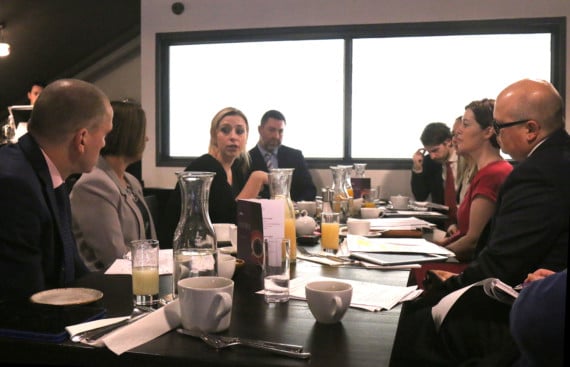
A group of respected professional men and women were fired up for a high-powered roundtable on gender diversity in the workplace with particular attention on the finance industry.
The event, hosted by KPMG, took place in time for International Women’s Day, being marked today (Thursday).
Before the enthusiastic group were many statistics, including results of research from KPMG to show companies with diverse boards in terms of race, social mobility and gender, perform better.
Yet the ’internal pipeline’ of executive female talent currently feeding into board positions ’is not strong’ according to the research by the audit, tax and advisory giant.
.jpeg?width=209&height=140&crop=209:145,smart&quality=75)

It also said: ’At executive committee level we cannot confidently predict a timescale for women to ever reach a 30 per cent tipping point.’
However, statistics aside, the wide-ranging discussion held over brunch at the Seven Kingdoms Distillery in Douglas, was hailed as positive and the group were convinced the island could really do more to advance gender parity in the Isle of Man workforce.
These were the people taking part in the roundtable:
Simon Nicholas, partner at KPMG.
Karen Corran, head of HR, Hansard Global and chair of the Employment and Skills committee for the Chamber of Commerce
Laura O’Sullivan Spiers, senior audit manager at KPMG and member of the Chamber of Commerce Fuel Group
Andrew Newton, associate at Cains and member of the Chamber of Commerce Fuel Group
Peter Kenny, managing director, Old Mutual International
Katherine Ellis, group director, Boston Multi Family Office
Leanne McKeown, director, DQ Advocates
Estelle Spiers, director and group head of operations at Zedra
Simon Scott, country head of Barclays Isle of Man
important
Simon Nicholas, from KPMG who chaired the gathering, got the ball rolling by saying: ’Diversity and inclusion is such an important matter to us at KPMG, not just from an internal point of view, but for the good of the finance industry and the island as a whole. KPMG has done a lot of research in this area so I already had very strong views on this matter, but in the run up to this discussion I reached out to colleagues, friends and family and it was interesting to gain valuable insight from different perspectives, perhaps viewpoints that I might not have considered before this.
’As business leaders we have the opportunity to make a real difference and the Isle of Man could establish itself as a world-leader in diversity and inclusion. I’m sure all the companies around this table would be very keen to support Government on diversity and inclusion initiatives that can help in the short and long term.’
Mr Nicholas said gender and diversity was getting a lot of air time at the moment because of issues such as the UK gender pay gaps that now have to be disclosed for any company with more than 250 staff.
He said that in the KPMG studies it was found men were earning 18.4 per cent more than women.
’But actually the gender pay gap can be misleading. It’s more about diversity, and the proportion of men and women at all levels of organisations. The pay gap is normally due to the larger earners being male rather than companies purposefully paying men more than women. Most responsible employers know this and have pledged to do something about it - KPMG included.
’It may take a generation or two until parity but initiatives such as International Women’s Day help to ensure that diversity and inclusion is not a fringe discussion but a critical business issue. It will require changing attitudes in society, among employers and in government to be successful. Legislation such as paternal and grandparent leave that is well marketed and embraced by all is much needed, as is a strong supply of affordable high quality child-care options if the island is to keep up with large economies.’
Peter Kenny, of Old Mutual International, said: ’We are a responsible employer and we are already active with respect to inclusion and diversity.
’We foster an inclusive culture. This means we are increasing employee awareness across the board about inclusion and diversity.
’We are also introducing flexible working principles. We are encouraging women and we are attracting diverse talent. We are also signed up to a diverse shortlist policy for recruitment.’
common sense
Mr Kenny said Old Mutual Wealth’s target is to have signed up to 35 to 40 per cent women in senior management by 2020.
’With respect to Old Mutual International here in the Isle of Man, our female representation is 45 per cent. Now I don’t credit that statistic to anything other than common sense.
’We never set out to achieve a quota, we never set out to consciously increase that level. We simply achieved it by doing things that in my opinion are wholly rational and wholly normal.
’When a person walks into the room in search of a job, I see the person, not anything else. Are they capable of doing the job?
’On one hand I’m very proud of that statistic - on the other hand it’s just another very normal outcome of what we do.’
He added that he agreed with Simon Nicholas that ’these statistics in front of us clearly demonstrate, there is a need for us to have these discussions and the industry still has to do much more to promote equality and diversity.
’As a business Old Mutual Wealth is very committed to promoting the diversity agenda and as our International business operating out of the Isle of Man we are supporting that agenda incredibly well.’
Andrew Newton from Cains said he had looked through some of the Isle of Man statistics and there were both ’strengths and weaknesses’ for the island.
He said that although there was still work to be done, the Isle of Man had a much higher representation of women at board or senior level than the European average, and this had improved significantly between the last two censuses.
Leanne McKeown from DQ Advocates said businesses could do a lot to change their culture and to be mindful that it is more often women who take time out from their career to look after children if they choose to have a family.
’If you think about bread-winning and care-giving, the stereotypical roles still arise.
’So return-to-work practices and initiatives and flexible working, they all have their place, but I think it is for employers to demonstrate that there is a value to family that is held in as high an esteem as a value to work.
’I think businesses have a duty themselves to actively encourage and facilitate their male employees to take a leading role in care giving, but there needs to be support from government in that regard.’
She noted that Policy Minister [Chris] Thomas had raised the issue of Shared Parental Leave as something the Department of Enterprise planned to include in the next Employment Bill.
’I think juggling work and family is not [just] a woman’s problem. Businesses need to be mindful of that and be actively supporting the introduction of shared parental leave, then taking steps to encourage male employees to take the time out.’
shared
Agreeing with Leanne, Estelle Spiers from ZEDRA, said she looked forward to the day when any colleague, male or female, finds it acceptable to be involved in shared parental tasks such as the school pick-up.
Estelle went on to say that she felt that in her organisation, progression was key, with many more men taking equal responsibility for parental care and feeling it acceptable to take on this role.
Estelle said that she had pushed the boundaries of what was possible when she had returned to work after maternity leave to obtain a satisfactory work life balance by making use of flexible working policies and remote working capabilities. Estelle said she actively encourages others to find this balance.
Karen Corran of Hansard said: ’At Hansard, we have invested time to ensure flexibility is available when required for all of our people, regardless of gender. Our last Employment Engagement Survey evidenced that 84% of our people feel they are able to strike the right work life balance.’
Leanne McKeown, from DQ, said that when she moved to the island six years ago she knew nobody here except for her husband, who works in construction and initially it was difficult to access business networks.
Leanne commented that she had noticed in the past 18 months [since becoming a director]: ’I get invited to more events, which is great and I go to a lot of them. What strikes me however is that the business events on island, the talks and the great things that are happening in the finance sector, are still predominantly attended by men.
’I get invitations to events as a director that I did not get when I was a senior associate. There is no reason I would not have got them as a senior associate. I consider that I simply became more visible the moment I became a director.
’We have a majority male leadership within the business community on the island, but we can nevertheless recognise this and thereafter take steps to reduce the gender disparity at industry events.’
Katherine Ellis from Boston said her experience had been different in that she had worked for as many female bosses as men in her career on the Isle of Man to date, and that had been very helpful for her. ’It’s important that young professionals get a diverse experience, particularly in terms of the mentoring available to them.
’I benefitted a lot from having both male and female role models available to me. Proper coaching for those in mentoring positions in how to give prospective future leaders varied experiences will go a long way to helping ensure a more diverse future.’
Laura O’Sullivan Spiers from KPMG, who is originally from Toronto, said all the evidence suggested senior women actively seek out other women to join them in workplace positions. While she agreed we should not be seen to be filling quotas, she said: ’It is only when we can challenge the board-level leaders’ perceptions of why we should be promoting the right candidate for the role, whether they are male or female, that we will see a paradigm shift to gender equality in the workplace. Not just at Board level, but also because having more female leaders will influence the way rising female talent is mentored and encouraged.’
commitment
Simon Scott, Country Head of Barclays in the island, thought that the key enablers to change are leading by example and driving cultural change to make a real commitment to accelerating progress on gender diversity.
’We need actions not just words. We have to change cultures through coaching, mentoring and actively championing the development of women. Across our organisation and the financial services industry we hope to see more females in senior roles and we are determined to enable women to fulfil their career aspirations.’
Laura O’Sullivan Spiers commented on research from New York University where primary school pupils as young as six believed brilliance was a male trait, and that girls of the same age believed that in order to perform well they would have to try really hard.
’This statistic is obviously very concerning given that, at such a young age, choices can be made based on gender stereotyping and can have a significant impact on their educational trajectories and future chosen careers. We need to be doing more in early childhood and in schools to discourage this type of bias.’
Andrew Newton from Cains picked up on this by referring to a possibility of an ’unconscious bias’ manifesting unintentionally in job advertisements.
He said that some courses draw more male candidates at school and university level.
’Things like economics, business orientated subjects, analytics and maths courses.’
Mr Newton said that the framing of job descriptions could be managed so as to avoid any unintentional bias limiting the number of female candidates.
Karen Corran agreed that the number of female candidates available can be an issue. ’I have worked in the Finance industry for 20 years and in my experience there is a real shortage of senior female candidates.
’Over the last five years we have recruited for a number of senior roles and very few candidates, if any, in some scenarios, were female. There is real value in a diverse workforce but there are definite gaps to overcome.
Estelle Spiers said that she felt another reason why there may be a lack of female applicants for senior roles may relate to the fact that woman often have to take a difficult path to get into a senior role and once there the fear of starting again in a company which may not be as flexible could be very daunting.
Estelle also made reference to research which suggest that woman hold themselves back from applying for roles if they don’t feel they meet all the role requirements, where it has been proven that men will apply even if they do not feel they have all the relevant requirements required.
Leanne McKeown from DQ Advocates, referred to the ’massive benefits of mentoring. ’I think men who empower women are as vital to society as women empowering women.’
’Maybe, moving forward, in the future, with more female representation at board level, we will see young men being mentored by female leaders so they grow up in their business career to see strong female leadership as the ’norm’, which feeds into a greater respect for women in business and facilitates the closing of the [gender leadership] gap that currently exists.’
differences
Leanne stressed the business world should also be able to ’celebrate the differences between men and women.’
’But mentoring is something every business needs to look to. It comes down to recognising talent so that it can be nurtured in advance of promotions . . . and it’s gender neutral.’
Simon Scott said engaging men in the gender equality debate was very important.
’For example, I am being reverse mentored by a female who is also a millennial which has given me a different perspective on leadership and colleague engagement.’
Talking about millennial men and women Leanne McKeown referred to DQ’s so-called ’’Baby Board’’ previously publicised in Business News, which gives this age group more of a say in how business is conducted.
Simon Scott said a similar initiative was in place in Barclays, known as the Emerge network. Mr Scott said: ’I firmly believe that increasing diversity and fostering an inclusive culture are critical to success.’
Katherine Ellis saidshe felt Boston had benefitted substantially from having a balanced board in terms of gender, age, and background. She argued, however, that diversity isn’t just about internal policies and representation.
’External communications and outward facing policies also need to be included in any diversity strategy. Financial services firms have suffered from advertising aimed primarily at men, for example.
’A recent report commissioned by Boston showed that female clients, who now hold more than 30% of global wealth, feel that financial service firms don’t market to them effectively, so a large part of the market feels under-serviced.’
Peter Kenny said he heard a ’beautiful critique’ of the financial industry from a woman comedian compering an awards event in London.
’Her point was that the image often projected of finance companies was of grey haired men.
’She said: ’’Well wake up everybody, women have got money too.’’ I thought it was a beautiful critique of the financial services industry. That we project these images constantly. From job adverts to product brochures, we have got the balance wrong.’
Estelle Spiers from ZEDRA said she was quizzing her two teenage daughters about what would attract them into the finance industry, and they said: ’’Absolutely nothing.’’ Estelle said this raised the question of what were we all doing as members of the finance industry to attract the younger generation and encourage them to pick the finance industry as a career of choice.
Estelle made reference to some of the work other sectors are carrying out in schools such as the engineering sector to incentivise and educate students to choose engineering as a career. Estelle said she felt that the finance sector needed to be in the schools explaining the wide variety of roles within the industry that students may not think about such as project management, technology and other roles that they may not associate with finance.
perceptions
Simon Scott from Barclays said: ’We need to do more to promote the diverse opportunities in financial services in schools, universities and work experience programmes. This will help to change perceptions and understanding of the wide range of skills needed - it’s not just about financial products and numbers, there are so many different roles across marketing, HR, legal, compliance and technology.’
The roundtable agreed the financial services industry in the island had to evolve and on the suggestion of Katherine Ellis, ’to be nimble.’
The roundtable agreed with chairman Simon Nicholas that collectively, there is much more that the business community can do to champion an inclusive culture and promote diversity as a critical business need. He said: ’The island has made progress towards gender equality in recent years, particularly in the insurance, banking and professional services sectors where female representation is at least 50% of the workforce but there is still more to do to bring that level of representation through to senior management and board level.
’In the short term, we need to create environments in which all of our people feel valued and able to reach their full potential. In the long term, we can help to encourage young people into a career in finance to secure talent in the industry for the future. Now is the time to #PressForProgress.’
Simon Scott
Laura O’Sullivan Spiers
Peter Kenny
Leanne McKeown, left, and Katherine Ellis
Comments
This article has no comments yet. Be the first to leave a comment.