
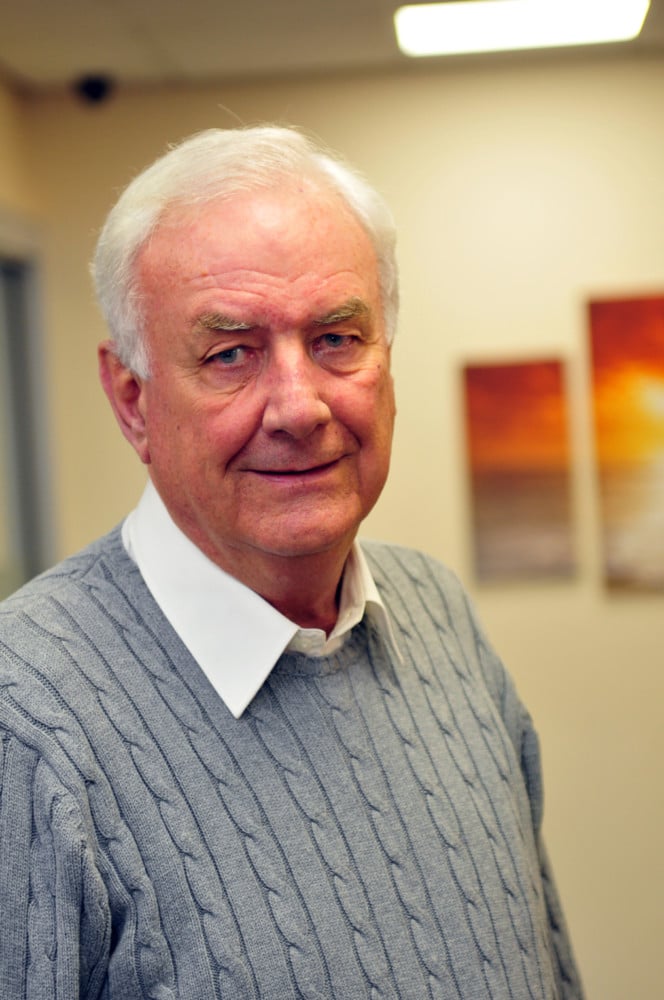
A former assessor of tax is calling for a review of the island’s income tax system - with a view to bringing greater fairness and securing more much-needed revenue for government.
Mark Solly has urged the Treasury Minister Alfred Cannan to set up a working party or commission to devise a ’coherent, meaningful and, above all, fair tax strategy for the future’.
He said: ’We are going bust and have to do something about it. The manifest unfairness of the present system surely cannot be sustained and the zero rate that applies to the taxable incomes of locally-owned companies is costing the government many millions of pounds.’
The answers to a series of Tynwald questions from Ramsey MHK Lawrie Hooper in June lifted the lid on the likely losses to government due to the taxable incomes of locally-owned companies being charged at the zero rate.
 New organ donation law to come into force as island urged to ‘make informed choice’
 Department outlines new education priorities as Tynwald receives updated plan
.jpeg?width=209&height=140&crop=209:145,smart&quality=75) Tynwald rejects referendum on Isle of Man's Net Zero policy
Tynwald rejects referendum on Isle of Man's Net Zero policy Operating the Isle of Man’s Liverpool ferry terminal costs more than £710,000 a year
Mr Cannan confirmed that in the year ended March 31, 2016, there were 8,048 companies owned or partly owned by individuals residing in the Isle of Man. These companies enjoyed taxable incomes of £871m.
If these companies had been charged income tax calculated at 20%, the government coffers would have been better off to the tune of some £174m.
The comparable figures for the previous year are even more dramatic.
Mr Cannan said that in the year ended March 31, 2015, there were 8,029 companies owned or partly owned by individuals residing in the Isle of Man. These companies enjoyed taxable incomes totalling £1,227m.
If these companies had been charged to income tax calculated at 20%, the yield to government would have been some £245m.
In general terms, an individual residing in the island who is able to accumulate part or all of his or her income (other than Manx rental income) in a company pays no income tax at all on that income.
Alternatively, an individual residing in the island who is unable to accumulate any part of his or her income in a company (i.e. usually an employee or pensioner) is required to pay income tax calculated on the whole of his or her income at the individual rates of 10% and 20%.
These employees and pensioners now represent the hard core of Manx income tax payers.
Mr Solly asked: ’Is that fair?
’Surely not. After all, individuals who enjoy the tax free facility are still entitled to all the various public services provided by government.
’It is not as if the government’s general revenue account does not need the money. An extra £150m/£200m a year would go a long way to solving at least some of the island’s current problems.’
He added: ’Who knows how long it will be before the Treasury will be looking to raise the rate of personal income tax charged on employees and pensioners from the current 20% to 21%, 22%, 23%, 24% or, even, 25% to meet the government’s necessary expenditures?’
Mr Solly is now calling upon the Treasury Minister in his next Budget to seek to bring more fairness to employees and pensioners by levelling the playing field between them and those who are able to enjoy the tax-free facility.
He said that a properly-staffed working party or commission should be established to examine the various options for a fairer system of income tax - one that better serves the needs of the government and people, meets the needs of the major trading companies not owned in the island and meets with the approval of the European Code Group.
’Clearly, something must be done to seek to improve the present situation,’ he said.
Mr Solly pointed out that the ’the tax-free facility’ is quite different from the ’tax cap’ for wealthy individuals arguing that while the latter is well-known and clearly in the public domain, the former is not.
Treasury Minister Alfred Cannan has now responded to Mr Solly’s points, which were first raised in this week’s Isle of Man Examiner.
The story is in today’s Manx Independent.
Comments
This article has no comments yet. Be the first to leave a comment.