
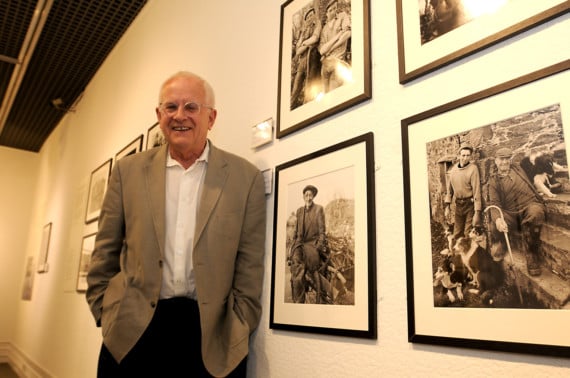
Chris Killip, one of the defining photographers of the late 20th century, died this week aged 74 after suffering with lung cancer.
Described as one of the most influential photographers of his generation, Chris defined reportage and documentary photography from the 1970s through to the late 1990s.
His gritty and powerful collection of images, published in his book ’Chris Killip: In Flagrante Two’, followed by ’Seacoal’, taken in the working class, post-industrial areas of the North-East of England during the decline of the ship-building and mining industries cemented his reputation as an unflinching but sincere and humane photographer.
However it was his work documenting the changing of the times on the Isle of Man at the start of the 1970s that created one of his most endearing projects.

.jpeg?width=209&height=140&crop=209:145,smart&quality=75)
Over a period of three years he photographed farmers and their families across the island, capturing the end of a traditional way of life in all its hardship and humanity.
He re-edited his Manx collection in 2015 in his book ’Isle of Man Revisited’ and in 2016 met with many of his subjects once again at the Manx Museum during an exhibition of his work.
Chris was born in Douglas in 1946, attending Ballakermeen High School. After a summer spent working as a seaside snapper on Douglas beach, Chris eventually left for London to work for a commercial photographer.
Following his success with ’In Flagrante Two’, Chris won many prestigious awards and accolades and eventually moved to America where he retired in 2017 as professor of Visual and Environmental Studies at Harvard University.
His close friend Nigel Kermode, who displays Chris work on the walls of Greens cafe, in St John’s, paid tribute.
’He still loved the Isle of Man,’ said Nigel.
’It was in him. He had that desire to capture that essence of nostalgia and Manxness in the way that he did.
’He recorded the social life of people and had the foresight to see how life was going to change.’
Comments
This article has no comments yet. Be the first to leave a comment.