
If you live in the island you’ve probably eaten Coole Girl eggs, even if you didn’t realise it. They’re the tasty ones with the rich golden yolks that they serve poached on sourdough toast at Noa’s Market Hall cafe.
They are also used by many of the local baking businesses in their large cakes and cup cakes and you can find them at Robinson’s and other local shops.
Strictly speaking there are four Coole girls behind the brand.
Belinda Coole started farming at Ballamodha Mooar with her husband, Dougie, in 1986, the year they wed.
.jpeg?width=209&height=140&crop=209:145,smart&quality=75)
.jpeg?width=209&height=140&crop=209:145,smart&quality=75)
.png?width=209&height=140&crop=209:145,smart&quality=75)
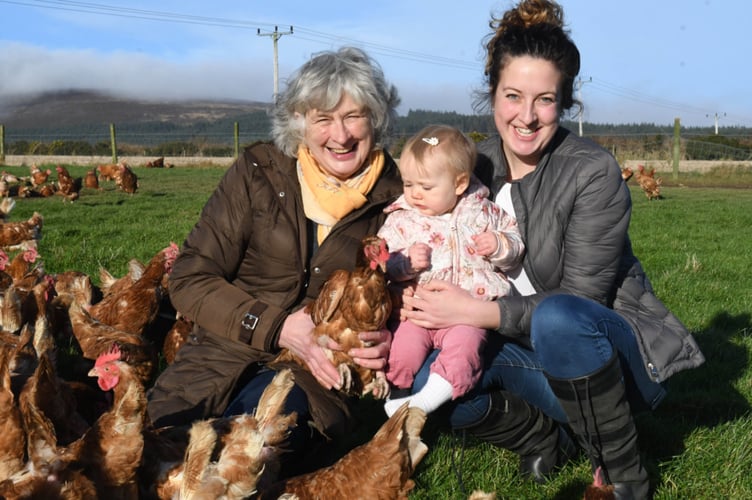
They have two daughters, Kayleigh and Sarah, and a granddaughter, Pippa, who is Kayleigh’s daughter. Despite being only 11 months old, Pippa qualifies as being part of the family business by virtue of the fact that she accompanies nana Belinda on her daily egg delivery round.
Sarah is currently living in London and Kayleigh also left the island when she was younger, spending a year working on a dairy farm in New Zealand, but she has been back for seven years now.
She lives just up the road from the farm with her partner, Craig, and is very much a part of the family farming enterprise.
The main business of the farm is dairy, supplying Isle of Man Creamery with milk. The egg business started in a very small way.
Belinda says: ’The hen business moved from a dozen hens in the back yard when the girls were at school and it grew organically really.’
Kayleigh says: ’It was a little sideline project for me and Sarah, collecting the eggs and selling them to the shop, and then when I came home we needed a few more cows and a few more hens to pay for an extra wage.
’So we took a leap of faith and bought a substantially bigger hen house and a substantial amount of more hens, and went for it.
’Luckily there was lots of local demand and it picked up quite quickly with shops and restaurants coming on board and it’s just grown really.’
The Cooles now have three henhouses and just over 1,000 hens, all free range. The breed they keep are Lohmann Browns, which are bred from Rhode Island and White Rock lines, specifically for their egg-laying productivity.
They are free to roam on land which has been planted with a free range grass mixture, specifically designed for hens to graze on. It never grows very tall but has deep roots so they can’t scratch up the plants.
Kayleigh says: ’It does give the eggs great flavour and colour and it’s more natural. It also has a lot of wild flowers in it and they do like picking at the poppies.’
They also get a special layers’ crumb which they go into the henhouses to eat. This is particularly important at the moment, as the current threat of avian flu means that birds should not be fed out of doors because this can attract wild birds who might be carrying the virus.
Like most hybrid hens, the Lohmanns will lay all year round during their most productive years.
’But obviously it is a seasonal thing and they will lay more in the springtime and that is the trick, getting the balance:. You’re at the sweet spot for about two weeks then you’ve got either far too much or not enough,’ says Belinda, a sentiment that will be echoed by many hobby poultry keepers.
She goes on: ’The initial lockdown was interesting because it seemed to spark some sort of baking revival. We struggled to meet demand then, in spite of obviously losing our trade at Noa,which was closed, and it was quite challenging then to keep every customer happy. But it’s settled down a lot and things have evened out again.’
The young birds will start by laying small eggs at first.
Belinda says: ’It’s always a challenge, selling the little eggs, and we do support the Foodbank if there is extra. Once they start laying bigger eggs they’re no problem to sell.’
Like all poultry keepers, the Cooles have to deal with what appears to be an increasing number of polecats in the island.
Belinda says: ’They’ve always been a problem, especially in the autumn.
’We have live capture traps set up round the henhouses and it’s surprising what wildlife we catch in them. Lots of hedgehogs go in, and domestic cats, and we’ve had a couple of rabbits - even the odd bird will get caught in it.’
One thing the family enjoys is showing their Dairy Shorthorn cows at the agricultural shows. Despite claiming that they are ’not very organised’ when it comes to showing, they have had some notable successes, in including winning the Rose Bowl for Supreme Champion at the Royal Manx Agricultural Show on a number of occasions.
In 2017 they submitted a photograph of their supreme-winning cow, Millennium Boundless Bramble to a national competition for Shorthorns from all over the UK. She won that and went on to represent the UK in the world shorthorn competition, in which she came second.
’Bramble is still going: she’s the queen of the herd,’ says Belinda.
l Just a few days after Food & Farming page visited the Cooles, the news broke of the first suspected case of avian flu on the island.
This has since been confirmed.
All poultry keepers in the island are being asked to house their flocks and the public are advised not to touch ill or dead birds as a precaution.
You can find out more information about avian influenza at https://www.gov.im/birdflu
Comments
This article has no comments yet. Be the first to leave a comment.