
There are many traditions, stories and customs in the Isle of Man, some of which are still enacted and recognised today, and some of which have vanished into the mists of time.
September is the time of year for music, feasting, and dancing with the harvest baby.
The harvest was so important in the traditional Manx calendar that the Manx for ’September’ is ’Mean-fouyir’- the middle of harvest.
Large numbers of people were needed to take in the harvest before mechanisation.
.jpeg?width=209&height=140&crop=209:145,smart&quality=75)

-(1).jpeg?width=209&height=140&crop=209:145,smart&quality=75)
.jpeg?width=209&height=140&crop=209:145,smart&quality=75)
Teams of men, women and children would work until only the final handful of corn was left.
One of the women, often the youngest of them, was then called upon to act as the Queen of the Mheillea, or Harvest Queen, to cut these last stalks.
The Queen then held this last sheaf aloft to shouts and cheers.
’Hurray for the Mheillea! The Mheillea is took!’
Then came a great feast in the barn laid on for all the workers by the farmer.
All manner of hearty Manx food was on offer, from ’porrage an’ dhry lumps’ to barley bonnags.
And, of course, there was always ’an abundance of strong beer’!
The grateful workers ate well. It’s not by chance that there is a Manx saying: ’Dy ee goll-rish folder’ (To eat like a mower)!
The pride of place was given to the Babban ny Mheillea.
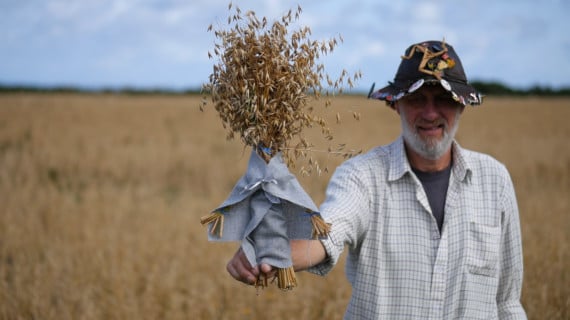
This ’harvest baby’ was a figure made from the last sheaf.
About 12 inches high and decorated with ribbons and wildflowers, the Babban was plaited and tied into a female figure with the ears of the corn as the head.
Dancing to the fiddle was once legendarily popular amongst the Manx, and the Mheillea celebration was no exception.
The benches were pushed aside and the dancing was begun, with the Babban ny Mheillea danced in the Queen’s arms in the middle, or passed around amongst the young women.
John ’Dog’ Callister, the well-known expert on local and rural customs of the Isle of Man, recently created his own version of a Babban ny Mheillia.
The raucous time of ’reel on reel and jig on jig’ had the fiddler barely able to catch his breath as the dancers were wet with sweat and the women’s ’ankles clane and calf near bare.’
But, as George Quarrie wrote in 1880: ’With jough and fiddles, who cares a fig about tomorrow!’
It would have been late into the night before the celebrations at last drew to a close, and the Babban ny Mheillea was carefully lain on the farmhouse chimney piece.
Here it remained for good luck until the next year when the process began again.
Wonderful traditions like this, with ceremonies of queens and babies, have had attempted explanations which point back to pre-Christian harvest gods and rites, but Manx traditions will always elude a final explanation.
However, the next time you are at a mheillea auction, or taking part in the ’Yn Mheillea’ dance at a ceili, we hope you might feel a little more connected to this wonderful Manx tradition.
by James Franklin
Online and Educational Resources Officer
www.culturevannin.im
Comments
This article has no comments yet. Be the first to leave a comment.