
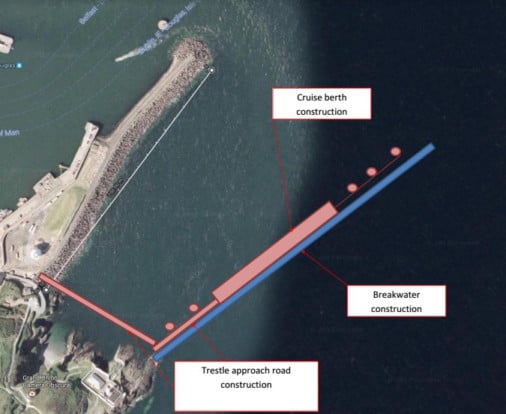
A new deep water landing stage in the Isle of Man could be a fantastic asset, boosting tourism, supporting the island’s heritage attractions and pumping thousands of pounds into the economy.
That’s the view of the current and former chairman of the Shipping Association, Mark Robertshaw and Lars Ugland, who say the project could even by in place by 2020.
The Isle of Man could benefit from cruise liners in the same way as the Orkney Islands, they believe.
More than 120,000 tourists are expected this year in the Orkney Islands. That’s six times the number of people who live there.
.jpg?width=209&height=140&crop=209:145,smart&quality=75)
.jpeg?width=209&height=140&crop=209:145,smart&quality=75)
The number of tourists to visit the islands was just 36,000 in 2011.
The developers’ ambitious proposal would see a new fixed landing stage built on the seaward-side of the breakwater that protects Douglas harbour. The latest proposal supersedes earlier plans for a floating berth.
The proposed new landing stage would be parallel with the existing breakwater and would offer berthing for cruise ships up to 400 metres, the current largest being 362.
Mr Ugland said the scheme would give the island a great opportunity to make the most of the growing cruise ship trade.
Larger cruise ships currently visiting the island have to moor in the bay and use small tenders to get passengers ashore, meaning bad weather can prevent any visitors from ever reaching the island. Smaller cruise ships can dock at Douglas but with the trend towards ever larger vessels the weather becomes a bigger factor.
’Cruise ships are only getting bigger and bigger, there will be fewer and fewer small cruise ships in the future,’ Mr Robertshaw said.
Some cruise ships have already struck the island off their itinerary because of problems getting passengers on shore.
Mr Robertshaw said: ’If ships can’t berth we will fall off the cruise ship itinerary so all the work done will be lost because we will be seen as an unreliable berth.’
This year, 27 cruise ships are due to visit the island, but all are smaller vessels with none of the larger ones taking the risk.
’We’ve been working with the government for some time and in September it will be four years since I first wrote to them. Since then we have gone through various proposals,’ he said.
The latest propsal, developed with Royal Haskoning DHV, a Dutch engineering and design company with offices in Liverpool, is for a fixed berth, which would cost around £35 to £40 million.
A presentation to government earlier this year from Mr Ugland, Michael Morrison, business development manager for Orkney Islands Council’s marine services and Angie Redhead, cruise manager for Liverpool City Council said the berth in Orkney had generated around 140,000 extra tourists each year. In 2016, they welcomed their 750,000th cruise ship passenger. Earlier this month, the Isle of Man welcomed its 50,000th cruise passenger.
Mr Ugland added: ’They say around 40,000 come to the TT in a two-week period, but one cruise ship per day, over 14 days, each with 3,500 passengers, could make a huge impact.’
Currently, they said Liverpool is looking at further investment in a deep water berth, which would complement anything here in the island.
’We are symbiotic with Liverpool,’ Mr Robertshaw said.
He added: ’The average cruise passenger spends around £70 in the island during their visit, giving a boost to the retail, restaurants, cafe and heritage attractions like the horse trams, railway and electric trams. And 20 to 25 per cent of those visitors tend to return if they have had a positive experience.’
The men say the money could be raised from private finance and need not cost the taxpayer anything. The construction would also use Manx workers.
A report on the landing stage’s viability was commissioned by the government from Deloitt’s and that is due to be completed in a couple of weeks’ time.
Chief Minister Howard Quayle sounded a note of caution saying construction of the Orkney berth was a relatively easy project compared with what would be required in the Isle of Man.
’I support it as a project but we have to be sure that the business case stacks up first. There are difficulties involved, for example the electricity cable may need to be moved and the tide falls by something like seven metres.
’But with Liverpool aiming to be the cruise centre of the North West, the opportunity for ships to visit will be significant. I will be happy to support it if it’s right for the Isle of Man.’
No decision is expected from Tynwald until the end of this year at the earliest and the berth would take around two years to construct.
Comments
This article has no comments yet. Be the first to leave a comment.