
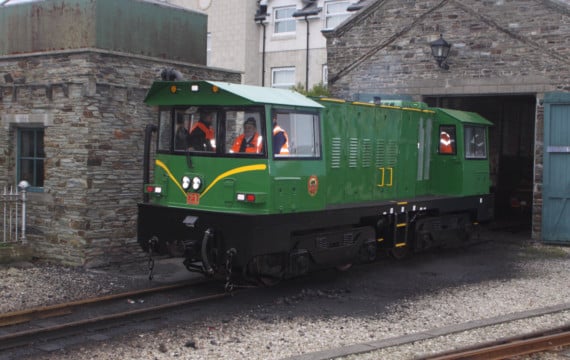
A government minister has admitted that spending £400,000 on a diesel locomotive was a mistake.
The locomotive, dubbed ’the cabbage’ was bought from the United States in 2013 with the intention to recover broken down trains, operate the fire train, assist heavy trains up the bank at Douglas and to haul works and special trains such as the TT commuter services.
At the time, it was claimed by transport chiefs that it would save the railways nearly £40,000 a year and would have paid for itself within 13 years, though it is believed it has pulled less than 35 passenger trains in this time.
failure
.png?width=209&height=140&crop=209:145,smart&quality=75)

.jpeg?width=209&height=140&crop=209:145,smart&quality=75)
But Minister for Infrastructure Ray Harmer MHK, has admitted the purchase was a ’failure on a number of different points’.
Since the diesel locomotion arrived on the island, it has suffered with overheating problems, engine issues, air intake and a loose tyre fitting and has not worked since 2015.
Mr Harmer, who was not a member of Tynwald when the engine was bought said: ’It is my understanding that it wasn’t the vehicle that was wanted or requested originally. It was a cheaper alternative and sometimes that’s what happens when you get a cheaper alternative.
’I hope it will work, but at the time, they tried to make a call, maybe not the right one.’
In 2012, when buying an engine was first proposed, then Minister for Community, Culture and Leisure Tim Crookall MLC said: ’I promised to review the original proposal to buy a new locomotive at a cost of about £750,000. Whilst there was and indeed is a lot of merit in that proposal, it is hard to justify that amount in the current fiscal climate.’
Mr Crookall pointed to purchasing a Russian-built model, however the decision was made to buy an American one.
Mr Longworth has previously said: ’On balance the secondhand American loco was better value in terms of the number running and the knowledge that people had of them.’
It has also been noted that several parts of the ’new’ locomotive were in fact more than 40 years old. Mr Harmer said: ’There are lots of priorities with our heritage railways but often in these cases it is better to spend properly rather than if you like, take the cheaper alternative. If there is an alternative, it has be to be a viable alternative, I think lessons have been learned by this.’
The diesel engine has been used for a simulation set up in the railway museum in Port Erin where enthusiasts are given the opportunity to experience driving it from Douglas to Port Soderick and back.
Due to the popularity of the simulation, it is likely the engine has covered more virtual miles than real ones.
Comments
This article has no comments yet. Be the first to leave a comment.