
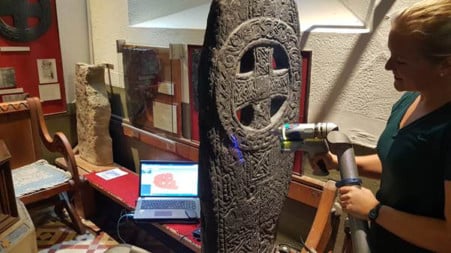
All 210 Manx crosses are to be scanned and turned into 3D digital images.
The project has been launched by Manx National Heritage, with the help of Lancaster University, the University of Southampton and software company Knowledge Intergration.
The stones are a key part of the island’s history with their creation dates ranging over several centuries.
Once scans are complete they will record the current physical condition of the crosses in superb detail along with the plans for their preservation in the future.



As well as being preserved for research purposes the crosses will also be available for education and recreational entertainment.
The pictures will be produced using state of the art laser scanning equipment in order to give the most accurate recreations of the stones.
Head of professional service for Manx National Heritage Kirsty Neate said: ’For the purposes of conservation, the highest possible accuracy and precision is needed.
’Recent advances in laser scanning have, for the first time, made this possible. Detailed scans will capture the surface of the crosses to a resolution of one tenth of a millimetre.’
She continued: ’Scanning the crosses posed a number of challenges including difficulties of access in remote locations and cramped display conditions. The objects themselves are mostly dark in colour which makes scanning much harder and the detail we are aiming to capture can elude the untrained eye.’
To help with the recordings the Manx National Heritage has secured the help of Dr Murrieta-Flores from Lancaster University.
She is a leader in the digital recording, interpretation and communication of archaeological remains and will be a great help to the project.
Crosses can be found across the island. One third of the crosses are located in several Manx churches allocated to their own places in the grounds.
A further third are found in two public shelters at Kirk Maughold and Lonan old church.
The final third are within the walls of the Manx Museum either on display or away in the stores and achieves.
Stories told on the crosses depict the island’s conversion to Christianity in 5th and 6th centuries right up to the reorganisation of the church in the 12th and 13th centuries.
Detailing on the stones shows the culture and diversity throughout the history of the Isle of Man.
Carvings found on the crosses include letters from the Ogham, Runic and Latin alphabets, with others including names and scenes from Christian and Norse mythology.
Scans of the crosses will be available to view from early 2019 at www.imuseum.im.
Comments
This article has no comments yet. Be the first to leave a comment.