
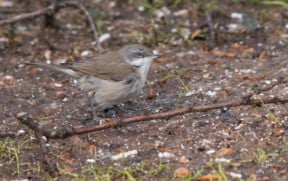
Birdwatchers have extracted DNA from faeces to establish the identity of a rare bird seen in the Isle of Man.
They have concluded that a rare warbler spotted in Ballasalla in January is from the central Asian population found in Kazakhstan.
Ballasalla resident Paul Bromley first spied the diminutive warbler on January 30 when it was feeding on fat balls put out by his neighbours in their back garden.
Paul alerted local birdwatcher Peter Christian, who in turn contacted Neil Morris at Manx BirdLife.
.JPG?width=209&height=140&crop=209:145,smart&quality=75)

.png?width=209&height=140&crop=209:145,smart&quality=75)
From its appearance, it was presumed that the bird was most probably a form of Lesser Whitethroat of an unknown eastern origin.
To solve the identity, Neil Morris collected a sample of the bird’s faeces - conveniently deposited on the garden fence by the bird - and sent it for analysis to Professor J. Martin Collinson at the University of Aberdeen. Professor Collinson is the world’s leading authority on the DNA profiling of wild birds from around the world.
After detailed DNA analysis, Professor Collinson confirmed to Manx BirdLife that the bird was a Lesser Whitethroat of the sub-species blythi.
The population of this form of Lesser Whitethroat breeds in central Asia in and around Kazakhstan.
It is likely that the bird got its migratory instincts wrong, heading north and west last autumn instead of south to its usual wintering grounds in southern Asia and east Africa.
The journey from Kazakhstan to the Isle of Man (as the ’Whitethroat’ flies) is about 3,200 miles.
The bird was last seen in mid-February.
Birdwatchers hope that it will find its way back to its nesting grounds in Asia this spring.
A similar-looking bird was spotted a few years ago by local birdwatcher Pete Hadfield.
Although the bird stayed for two days in February 2014, it was not possible to get a DNA sample and so its identity remains unproven.
Hence this year’s bird is the first ever ’Eastern’ Lesser Whitethroat proven to have visited in the Isle of Man.
The charity Manx Birdlife says it is indebted to the garden’s owners, Peter and Lynne Cain, for allowing access to photograph and collect a faecal sample from the bird and to Professor Collinson for agreeing to undertake DNA analysis.
Comments
We've recently changed our login process. If you have an account for commenting, you will need to re-register on the login window.
This article has no comments yet. Be the first to leave a comment.