
Could you eat only food whose origins you know for a week? Julie Blackburn has been giving it a go.
Farmer and Countryfile presenter Adam Henson, who will be visiting the island later in the year for the Isle of Man Food and Drink Festival, is among the celebrities who have taken up the challenge.
The idea is to eat and drink only produce with a known origin, back to seed or birth, and it’s aimed at making people think about where their food comes from and eventualy creating a more transparent food chain.
From a consumer’s point of view, knowing where things like veggies, meat and fish come from mean you also have access to information about use of pesticides, product freshness, animal welfare and, when it comes to fish, sustainability.



.jpeg?width=209&height=140&crop=209:145,smart&quality=75)
I thought I would give it a go, too.
As a starting point, I log in to the Food Assembly, the online market which connects consumers with a range of local suppliers.
I decide on a pile of veggies from Bry Rad, a grower from the north of the island who has become something of a Facebook star with his quirky posts. My order includes kale, golden, white and red beetroot, carrots, onions, Savoy cabbage and Maris Piper potatoes. I am now well on my way to having covered vegetable accompaniments, chips, soups, stir fries and winter slaw.
The latter is a family favourite and dead simple to make: take a couple of good-sized carrots, an apple and a couple of medium raw beetroot (the golden ones are the nicest but red will do fine), Grate it all in a food processor and dress with a tablespoon of Ellerslie rapeseed oil whisked together with two tablespoons of Staarvey Farm’s Sweet Raspberry Vinegar.
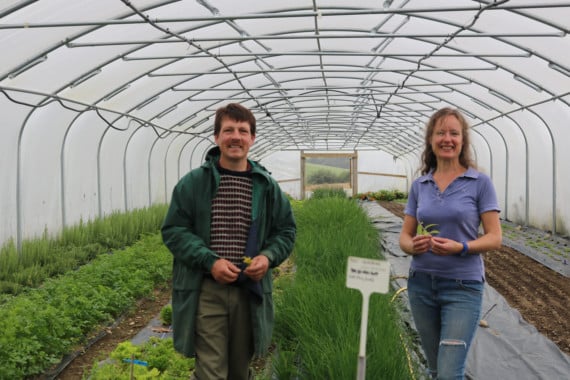
Stephen and Jenny Devereau, who own Staarvey Farm, grow wonderful summer salads and herbs (available in season from Shoprite) and are the island’s only certified organic food producers. I ask Jenny whether they also grew the raspberries for the vinegar.
She tells me that they don’t but they do pick them at Whitebridge Farm in Onchan so they are still traceable and she adds: ’We grow courgettes which are in our chutneys and I also pick hedgerow stuff - rosehips, rowans, blackberries, currants and hawthorn for our jams and jellies.’
Sadly they don’t sell apples and I fall down on that ingredient: the one I used was listed as coming from, variously, the United Kingdom, Chile, France, New Zealand. Hmmm.
We eat it anyway with the justification that at least we’ve thought about it.
For a family meal on Sunday I splash out on a piece of beef brisket from Will and Janette Qualtrough at Ballakarran Farm. They rear their own pasture-fed lamb and beef and if they can’t supply their meat they source it from Isle of Man Meats.
I give them a ring to ask about the piece of beef I bought and Will tells me that on this occasion it was from Isle of Man Meats so, whilst we don’t know the particular farm, at least we know it was Manx.
This is an important point because many people assume that if they buy their meat from their local butchers it is automatically from a farm in the island but this is not necessarily the case so always ask.
Most butchers are happy to tell you whether or not the meat is Manx and some of them can tell you exactly which farm in the island their meat has come from on any particular day.
Finding traceable beef and lamb is not usually a problem but pork can be harder to come by as there are not many pig farmers left in the island.
Alan and Rachel Teare at Ballakelly Farm in Andreas sell home-reared beef, pork and lamb direct from the farm where they also have a butchery and make their own sausages and pies.
’We buy our carcases back from Isle of Man Meats whole so we know it’s all ours. With our meat, I could go and show you its mum and dad,’ says Rachel.
There are also a few farmers raising rare breed pork. One of these is Tracey Ridgway at Close Leece Farm on the Patrick Road who keeps Tamworth pigs. She has just opened a farm shop and she also sells on the Food Assembly: her Manx chorizo is delicious.
This brings me to another important point: it might cost you a bit more but you are certainly not being short-changed when you buy local, traceable food. Close Leece Farm and Ballakelly Farm are among the 15 Isle of Man food producers who walked away with 56 awards between them at the most recent Great Taste Awards, judged against producers from all over the British Isles.
Bread is another easy win when it comes to traceable: all the flour used by Ramsey Bakery and Noa Bakehouse (with the exception of Noa’s rye bread) is local and comes from one of 10 farms in the north of the island who supply Laxey Flour Mills.
You can also, I am told, find Manx-grown oats in Mornflakes porridge oats but they are mixed with others from the UK. It’s about as near as I can get to traceable for my breakfast porridge and I can top it with a dollop of Dairy Shed yogurt - made on a farm in Andreas from milk from the family’s herd of Ayrshire dairy cows - and honey from a beekeeper in Port Erin, bought at the local health shop.
When I check the pot of - cheaper - yogurt I usually buy from a well known supermarket chain its ingredients are listed as ’Milk from various countries’. Seriously - various countries? Which ones? And how fresh is it if it’s travelled around the world to get to my yogurt pot, rather than just a few miles on the Isle of Man to reach the creamery?
The more you start to ask questions about the origins of your food, the more questions arise, it seems.
As a family we eat quite a lot of eggs and we’re okay for those at the moment as our own little clutch of hens are laying but if they weren’t I would be buying the Cooil Girl eggs, which come from a farm on the Ballamodha and available in Spar stores around the island. There are also lots of farms selling eggs from the farm gate at this time of year.
So if I wanted to make a cake I could have local and traceable eggs and flour, along with butter from Isle of Man Creamery, but not sugar, nor chocolate, lemon or vanilla for flavouring. Pretty close, though.
And this is really the point, I suppose: we are never going to be able to trace back everything we eat but giving it a try at least makes us think about where our food comes from. It also, hopefully, encourages us to cook more of our meals from scratch rather than buying processed food and ready meals which are usually virtually impossible to trace.
The really good news is that, despite the fact that we are a very small island, it is also surprisingly easy to source good food that is local and traceable.
Comments
This article has no comments yet. Be the first to leave a comment.