
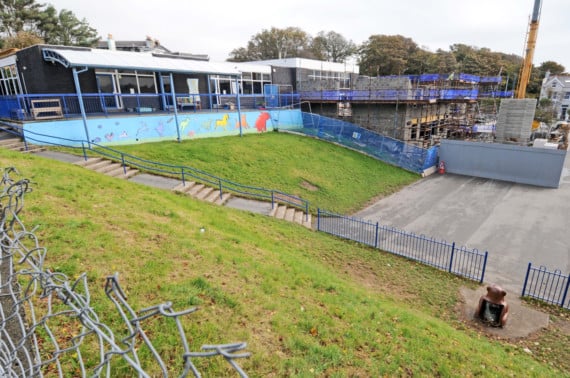
An action plan has been drawn up for an island primary school after concerns were raised at an inspection, the Manx Independent has discovered.
Issues at St Mary’s Roman Catholic School in Douglas emerged following a school self-review and evaluation exercise.
An external validation concluded the school ’does not know itself well enough’ - a judgement that could lead St Mary’s open to a possible departmental review or potentially even to a special inspection.
Geoff Moorcroft, director of education and head of the Education Improvement Service (EIS), declined to confirm what action would be, or was being, taken.




He said: ’The external validation report identified some areas of strength at the school but also some areas in which further development is needed.
’As is the case for all schools, the Education Improvement Service will continue to work with the school and offer support as it moves forward in addressing any concerns.’
Education Minister Graham Cregeen said it was his understanding that an improvement programme had been put in place.
He said he didn’t know if it had yet been fully implemented.
’No report has come to the department yet,’ he said, adding that St Mary’s was the first case he had seen where external validators had disagreed with a school’s own verdict on its performance.
The school’s headteacher, Tim Short, is currently on sick leave.
St Mary’s, where a £4.5m extension project is currently under way, is the island’s only Roman Catholic school and has a catchment area covering the Roman Catholic parishes of St Mary’s, St Joseph’s and St Anthony’s. It has 286 pupils on the role, just under a quarter of whom are learning English as an additional language.
External validator Howard Marshall visited the school on June 22.
He rejected the school’s assertion that achievement against prior attainment was ’very effective’, and concluded instead that pupils’ progress was only ’effective’.
The validation team could not concur with the school’s judgement that teaching for learning at St Mary’s was ’effective’ and ruled that it should be judged ’not yet effective’.
It said that partnerships with parents was also ’not yet effective’ in contrast to the school’s own judgement that it was ’effective’.
All schools are required to carry out on-going self-review, a process which is validated by an external validator appointed by the Department for Education, Sport and Culture.
Where an external valuation leads to a judgement that the school ’did not know itself well’ this would lead to more support and challenge from the Education Improvement Service.
And it may result in a departmental review or lead to a special inspection.
A DESC document on arrangements for monitoring and evaluation of schools notes that reviews may be helpful to ’give another viewpoint’ when schools ’struggle with particular issues’.
Reviews, which are carried out by EIS advisers and senior department officers, may be wide-ranging across all areas of the school’s work or may be narrowly focused on specific areas.
Special inspections are rare and are only carried out where a school either fails or refuses to engage ’with a problematic situation and/or the department’s assistance in dealing with a problem’, states the DESC document.
It continues: ’A special inspection of a school will be invoked where there is a serious concern about a school (or an area of work) of sufficient magnitude or nature that it is considered by the chief executive officer of the department to present an unacceptable risk’.
Comments
This article has no comments yet. Be the first to leave a comment.