
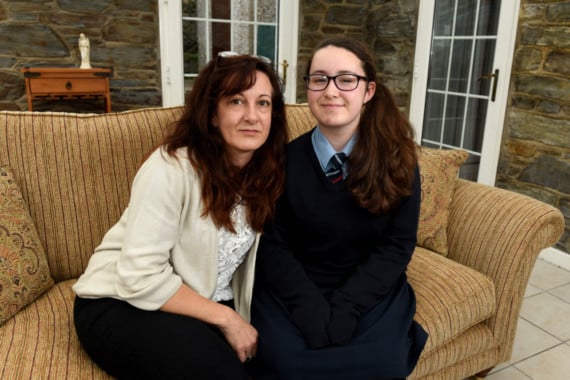
At the age of two and a half Erin begged her mum to let her have homework like her elder sister, Amber.
She could already write her name and by the time she was three she was learning to read.
Theresa recalls: ’She was just keen and eager, doing numbers and little adding up sums - she was just keen to absorb things from when she was very young.
’When she started at primary school she came home absolutely mortified because they gave her reading books with no words!’
-with-his-friend-Ash-Carter-(right).jpeg?width=209&height=140&crop=209:145,smart&quality=75)

It is clearly an added responsibility for a parent when their child displays so much potential at such a young age and Theresa has always been very much aware of the need to keep Erin stimulated and challenged.
Because the family were on the move during Erin’s early childhood she has attended a number of different schools which has made this harder.
Theresa explained: ’Because she’s changed schools so many times I think that’s had an impact on how she’s assessed at school.
’From day one Erin’s always been top of the class.
’There was no effort involved and my concern was that she didn’t have to try - she’s never had to try because it’s not challenging enough for her.’
When the family finally moved into their ’forever home’, in Colby, in July and Erin was due to start at Castle Rushen High School, Theresa and her husband, Alan, were asked to produce evidence of their daughter’s abilities.
They decided it might be useful to let Erin take a Mensa test.
The results more than confirmed what they already knew: at the age of just 12, Erin achieved the top score of 162.
Theresa said: ’No one wants to be that pushy parent but at the same time the ethos is that every child be able to achieve their best and their potential.
’Erin’s Mensa score is the highest possible score you can get.
’They don’t do a higher score so she’s maximum on that, therefore has Mensa even challenged her?
’How do you challenge her other than by broadening the topics she does?’
Luckily, she added, the teachers at Castle Rushen are doing their best to help:
’They are looking out for her at the school: they are looking for ways to challenge her because of the Mensa test: it was a marker.
’Erin’s not just doing well, she’s perfectly capable of more and more and more so they are acknowledging that now.
’They are looking at where she should be and what she should be doing and what else they can do to support her.’
Theresa also tries to help Erin to do some extra study at home.
Erin said: ’We’ve bought multiple books for self study: I’ve got the iGCSE maths book and some English and science ones.
’One of my teachers gave me the iGCSE biology book to take home and use so I’ve got that one as well.’
Theresa explained: ’It’s not a case of just pushing forward and forward, it’s keeping up her interest level and keeping her mind occupied.’
It also means that if Erin can get ahead, perhaps with maths, and maybe even pass her iGCSE early, it will give her some extra time at school to take on new subjects.
But when it comes to growing up, learning and intelligence are only half the story. It’s also about gaining emotional maturity.
Erin, who is delightful, may already have the eloquence of an adult but she still giggles and gets embarrassed exactly as you would expect of any pre-teen: ’I’m not very good in social situations,’ she says, blushing as she has her picture taken.
Theresa said: ’It’s quite hard for Erin because she has a good understanding of emotional maturity. She does lovely creative writing and I can particularly see it in her written work: she writes a lot about feelings and emotions and the whole understanding is there but that doesn’t mean she’s not still going to go through that process.
’You still physically have to go through feeling all those emotions and things on a personal level.’
It’s also important at Erin’s age to fit in and Theresa is very much aware that academic achievements are not necessarily considered cool: ’I think it would be easier if she had sporting achievements: they are comfortably recognised all over the place.’
Looking to the future, I asked Erin what she saw herself doing when she leaves school.
She said: ’My dream for a long time has been to become an author but I know that there is the financial trouble of getting published, getting accepted and just getting enough income from the book.
’So what would be good would be being a lawyer because you can look at the logic of the situation and argue your point but you do it logically and I enjoy that kind of thing.’
And, as Theresa pointed out, it’s not just the achievements that matter:
’Somehow we’ll find something that challenges her, that she has to fail at.
’I think learning to fail is quite an important thing in life and Erin hasn’t yet found something that she struggles with.’
â?¢ Mensa describes itself as the ’high IQ society’. Test your brain power with the Mensa workout at www.mensa.org
Comments
This article has no comments yet. Be the first to leave a comment.