
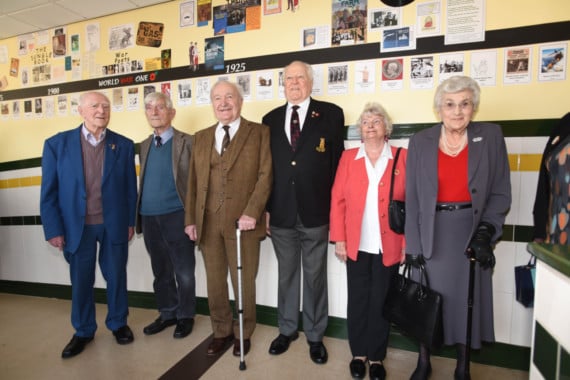
Key dates from history and literature have been compiled into a timeline by Ramsey Grammar School students.
The timeline, which stretches along a corridor of the school’s West Building and links the history and English departments, was unveiled on Tuesday.
Guests to the launch event included members of the Armed Forces Committee, Hector Duff, Brigadier Norman Butler and Major Charles Wilson.
Head of English Julie Owen came up with the idea for the timeline to run the length of a school corridor.




’The timeline was designed to link the two departments and we intend to use it as an interactive and dynamic educational resource,’ she explained.
’We hope that other departments will use the timeline to look at key points in their particular subject.’
Key dates from world history range from the death of Tutankhamun in 1323 BCE to the 70th anniversary last year of Ramsey Grammar School becoming the first comprehensive with 138 other events in between.
The literature timeline features great works and events in the world of literature ranging from Beowulf to Harry Potter and technological advances from the first ink printer to the introduction of the Kindle.
Head of history Andrew Wilkinson explained that students from all age groups and a number of interests engaged well with the project.
’We had numerous contributions from across the age range, some talented artists contributed and some of our ICT wizards contributed as well to produce materials for the timeline,’ he said.
’We all asked staff to contribute and received an excellent response.’
He said that with room for only 140 events in history to be included, a ’great deal of editing’ was needed to decide which events would make the final cut.
He said this sparked much interest and some controversy with students discussing events and publications that had been included and excluded.
The timeline has already been put to good use in lessons.
’Students have already started to use it,’ Mr Wilkinson explained.
’We have used it in the history department to illustrate events around the Industrial Revolution and the life of Winston Churchill.
’And the English department have used the timeline to illustrate the Gothic Period and have used it to look at the 1920s in context with Agatha Christie’s Murder on the Orient Express.’
At the launch, guests, staff and youngsters formed a human timeline by standing next to the date that they were born and looking to see what events were taking place at the same time.
Comments
This article has no comments yet. Be the first to leave a comment.