
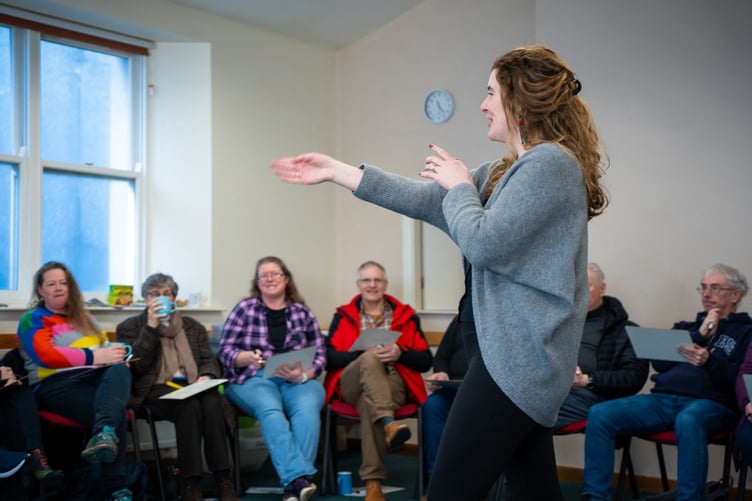
Each month, Culture Vannin’s Manx language development officer, Ruth Keggin Gell, contributes a column to Island Life.
As Yn Greinneyder (‘The Encourager’) for Culture Vannin, people often ask how I came to speak Gaelg (Manx).
They usually expect me to say that I grew up speaking the language, or that I learnt it in school. As someone who started officially learning in my 20s, you could say that ‘song’ was one of my first and most important Manx teachers.
Long before I could confidently hold a conversation in Manx, I was singing in it. Through songs, I encountered words and phrases repeatedly, naturally absorbing their sounds and rhythms. Melodies helped me to memorise Manx more effectively than vocabulary lists; we often learn song lyrics because music creates patterns that stick in the mind.


For lesser-spoken languages such as Manx, songs play an especially important role; they are often an easy first encounter for the language.
I have seen this happen time and again. Someone attends a concert and hears Gaelg for the first time, or comes to a singing workshop out of curiosity, sings with others and has fun, and discovers that they have begun their journey with the language almost by accident.
Their confidence grows and what began as an enjoyable hour or two of music has become an open door to another language.
Songs are also living vessels of language and culture; their rhythms can emulate dances, and their words can tell stories – encapsulating what people value, remember, celebrate or mourn.
‘Ny Kiree fo Niaghtey’ (The Sheep Under the Snow), for example, recounts the true tale of heavy snowfall in the 1600s, and the heartbreaking impact on livestock. It’s one of our oldest narrative ballads, and one that is still resonant today.
When we sing traditional songs, we bring new life to voices from previous generations, and our newly composed songs, by the likes of Biskee Brisht and Clash Vooar, demonstrate that Manx is continuing to evolve with fresh forms of expression. Through singing, we become part of a chain that links past, present, and future speakers.
These are just some of the reasons that I’m so passionate about singing and sharing Manx songs with others. Singing together removes much of the pressure people can feel when approaching a language for the first time.
It reminds us that languages are meant to be heard, spoken, and enjoyed together. Singing is good for you, and it’s also FUN! It reduces stress, releases endorphins, and helps us to be part of a physical community.
If you’re curious about Manx, or simply enjoy singing, I would love you to join me for a free Manx Gaelic song workshop on Saturday (June 27) from 1pm to 2.30pm in Laxey as part of a ‘A Manx Day Out’, hosted by Culture Vannin.
No previous knowledge of Manx is required and all are welcome. Sign up to this workshop via https://bookwhen.com/culturevannin#focus=ev-skhn5-20260627110000 or ring 676169.