

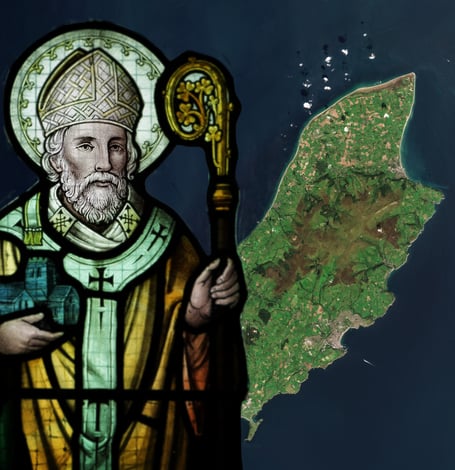
St Patrick’s Day, which is celebrated on March 17, is now a global celebration evolving from its humble beginnings in Ireland as early as the 9th century.
Although the saint is associated famously with Ireland, charity Culture Vannin shared a post this week highlighting his deep rooted ties to the Isle of Man.
Across the island, numerous places bear his name, reflecting centuries of folklore and religious heritage.
The most prominent examples include the parish of Patrick and St Patrick’s Isle, the small island now dominated by Peel Castle.
.jpeg?width=209&height=140&crop=209:145,smart&quality=75)
.png?width=209&height=140&crop=209:145,smart&quality=75)

However, these are just the most visible connections.
The parish church in Jurby, the site of Ballakilpheric, and many other locations across the island also reference the saint. In total, at least 18 keeills (early Christian chapels) and 13 holy wells are linked to his name.
According to Manx legend, Patrick arrived on the Isle of Man in AD 444, riding his horse across the sea.
The story tells that after turning a sea monster to stone and emerging through thick coastal mist, he landed on Peel Hill where he banished ‘venomous beasts, visible devils, and a multitude of magicians’.
This site later became a place of pilgrimage, with visitors drawn to the holy well known as ‘Chibbyr Pherick’.
Other parts of the island also claim links to his arrival.
Near the coast at Rushen, close to The Sound, a stone bearing what are said to be St Patrick’s footprints is preserved in a small protective structure.
Another curious site is Lhiabbee Pherick in Marown, meaning ‘Patrick’s Bed.’
According to folklore, the saint slept on a large rock there as an act of penance after cursing a nearby field.
These stories illustrate how St Patrick became woven into Manx culture and identity.
Celebrations of Saint Patrick’s Day - known locally as ‘Laa’l Pherick’ - continue to reflect that connection.
You can find out more from Culture Vannin online at: https://bit.ly/4lt5fXg