
Earlier this year, an advert we ran about dairy farming on behalf of a vegan organisation caused some controversy.
We had to run the advert because it got the go-ahead from the Advertising Standards Authority under whose rules we operate. But it got reporter Sam Turton wondering what the island’s dairy farms are really like. So this week he went to meet Juan Hargraves at Cooil Brothers Ltd to find out.
Juan and I addressed the vegan advert immediately. He said he understood why we had to run the advert and that he didn’t in any way oppose opponents of dairy farms to have their views.
’Vegans, like everyone else are entitled to have their opinions. We live in a free society. But I wouldn’t say what we do is cruel,’ he said.
’We keep calves with their mothers for at least 24 hours and monitor them to ensure they’re both healthy.
’After six hours, a calf needs to be taking its mother’s milk. If it doesn’t take to it naturally then we would assist in that.’
He said he wasn’t surprised at the anger directed at us over the advert as he said the farming community was ’very much appreciated and supported’ in the island.
For the first few days after birth, a cow produces colostrum. It contains antibodies to protect the newborn against disease before full milk is produced, which goes to the calves.
He said: ’Some see the milking process as cruel but cows produce far too much milk for their calves.
’So if we didn’t milk them, they would get inflammation of the udder - mastitis - which would be a major welfare and health issue for the mother and the calf and if untreated would most likely see both of them die.’
The calves are fed milk for about 10 weeks, and start eating solids from about two months.
Since October, the farm has had about 65 calves with a further 70 expected.
This, Juan said, is a key part of the bond he has with the animals. You know the cows and their mothers and most likely their grandmothers too,’ he said.
’We keep generations of cows so you become very attached and that’s important.
’Yes, we are a business and we do it to make a living, but it matters to us that the cows are well looked after. If we look after them, then they look after us. And that isn’t just us. Animal welfare across the island is of a very high standard.’
The farm, near Port Erin, will by the end of this year have about 100 to 130 cows as it is keeping all of its heifers and bulls .
After talking about the farm, it was time to go and meet the cows.
Juan showed me how the cows get milked. It involves a high-tech piece of equipment that filters milk and delivers it into a large container in the room next door.
The adjacent room, a large barn, is where some of the cows are kept at the moment.
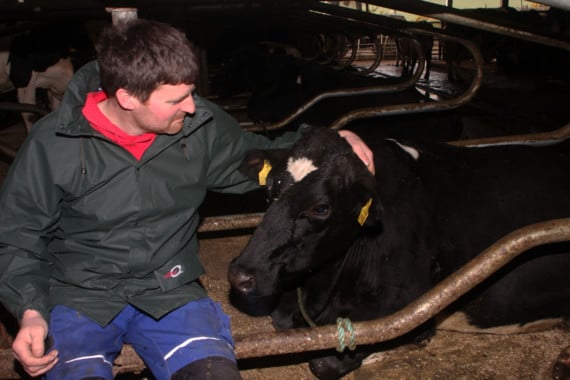
While I would never claim to be an expert on animal welfare or cows, there was nothing to me that would immediately suggest any of the cows were distressed or unhappy. They seemed quite happy with us walking about and as our pictures show, some even seemed to want to pose for photos.
To the side are the calves, some in groups in fairly large pens and the youngest by themselves in a row of smaller pens.
The youngest, only weeks old, are the most inquisitive, coming over for a look and smell. One of them even took to sucking on my fingers thinking they may provide food.
The cows are milked twice a day, at 5.30am by herdsman Mark and then again at 4.30pm by Juan.
Juan said that with two different people milking, it made it easier to pick up on any potential problems or welfare concerns.
About 65% of the milk produced is sold to Isle of Man Creamery, along with 31 other farms. The remaining milk is delivered to 900 doorsteps around Port Erin, Colby and Ballabeg.
Juan said: ’When I was a kid it was just milk. But these days, it’s whole milk, semi-skimmed, skimmed, so it’s a different job I suppose, with a lot more process involved.
’To enable this, we employ seven people, so we’re still quite a relatively small company. But we deliver glass bottles to homes and plastic ones to the restaurants and cafes. It travels less than about five miles from farm to delivered.’
The company is looking at how it can use more eco-friendly plastic bottles in the future.
Juan believes that openness to farming is important in the modern world.
’Anyone is welcome to see how we operate, have a look at the animals and see they are looked after,’ he said.
’We love people showing a genuine interest in what we do and are happy to show them.’
Search Cooil Bros on Facebook, email [email protected] or call 835508.
â?¢ Our new weekly Food and Farming page starts in this week’s Manx Independent. It will be in the shops on Thursday.
Comments
This article has no comments yet. Be the first to leave a comment.