
If you walk down the Silverburn River from Ballasalla to its exit into Castletown Harbour you will find the Golden Meadow Mill a few hundred yards from the sea.
Industrial Archaeology of the Isle of Man by Bawden, Garrard, Qualtrough and Scatchard describe it as being ’one of the most important and probably the first used sources of water power in Man’.
The mill complex, which is visible from almost all sides, rises out of the surrounding meadows like a beacon.
There has been a mill on the site since at least 1511, when it appears on the Manorial Roll as ’two grain mills near the castle’.
.jpeg?width=209&height=140&crop=209:145,smart&quality=75)
.jpeg?width=209&height=140&crop=209:145,smart&quality=75)
.jpeg?width=209&height=140&crop=209:145,smart&quality=75)
The tenant at that time was one William Hubart. It was one of the ’Lord’s Mills’ and one of the earliest town mills in the island.
Under the English Lordship, each parish had a mill, or perhaps mills.
Each farmer was assigned a mill where he had to take his grain to be ground into flour.
The miller took payment in kind for his services and paid the Lord for the right to use the water as a power source.
The parishes appear to have been set up in the second half of the 12th Century.
There were also grain mills upstream of the Golden Meadow Mill attached to Rushen Abbey.
In pre-Reformation days, the Cistercian Monks were known for their expertise in land and water management and for their knowledge of agriculture of which grain would have been an important part.
In Wood’s Atlas of 1867 the Golden Meadow Mill still appears as ’Mill rent near Castletown’ as part of the Abbey Demesne, however, the Proprietor is shown as Thomas Moore.
Its name seems to have derived from the flower-rich water meadows surrounding the mill.
These protected Castletown from flooding, and in turn provided rich pasture, used as common grazing land for the people of the town.
The cows would be stabled at the back of their houses, taken to the water meadows each day, then brought home each evening for milking.
The milk would then be sold to the people of Castletown.
The principal period of mill building on the Silverburn was in the 18th and early 19th century, and the current Golden Meadow Mill was built in about 1815 on the site of earlier mills dating back to the start of the 1500s or even the 1400s.
It was constructed by Deemster Thomas Moore of Great Meadow and was promoted in the Manx Advertiser of 29th February 1816 as ’Those most eligibly and newly erected corn and threshing mills at Castletown to be let for a term of years as may be agreed upon, and may be entered upon at May or November next.
’Conveniently situated for carrying on the wholesale business and commanding the custom of a very extensive neighbourhoodâ?¦â?¦...Apply at the proprietor, Mr Thomas Moore, Great Meadow.’
In addition to the existing mill buildings, there was a forge, pig sty and also another identical building directly opposite the mill.
Sadly, when the present owners bought the property in 1982, the latter building was dangerously derelict and had to be pulled down.
It is thought that it was used as a snuff mill at one time, and was certainly used as part of the rope works shown on the 1869 Ordnance Survey Map.
According to the authors of the 1972 book ’Industrial Archaeology of the Isle of Man’, the owners of the Castletown Mills were usually progressive and added other water-powered manufactures to corn milling.
There is a wonderful advertisement in the newspaper for 1920 announcing the arrival of ’A splendid pair of Diamond Brand Burr Composition mill stones, bought for a very high figure for Mr John Cowley (Miller) by Mr Thomas Moore, Billown - Mill stones for the future - they crush the poorest grain as if it had no husk’. Towards the end of its working life the mill largely produced animal feed.
The complex of mill buildings is very impressive.
The main mill is four stories high, it is made of local limestone then rendered.
On one side of the mill was a threshing mill and on the other is a drying kiln in a small extension attached to the main building.
The ’new mill’ is one of the largest on the island, and even now is probably the tallest building in the area with the exception of the castle.
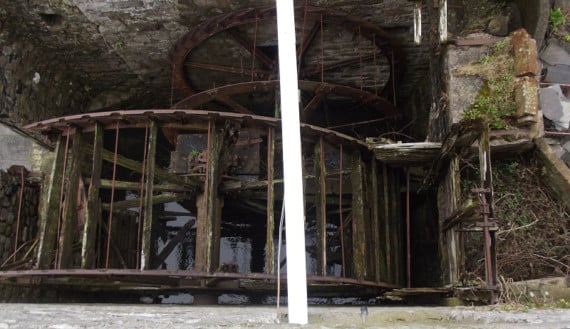
Unusually, there are two water wheels, one smaller than the other which stand side by side between the threshing mill and the main mill building.
Each wheel uses a different system - the larger wheel adjacent to the corn mill is an undershot, the smaller wheel adjacent to the threshing mill is an overshot.
The power for the millwheels came from the water stored in the mill pond which stood on an embankment directly behind the mill.
It was fed by water from the Silverburn River via a dam, sluice and mill stream some 500 yards upstream.
The millstream then continues on its way to the sea across the meadow.
Today, it goes under the railway line and the road, and then down behind Athol Terrace before disappearing into the harbour, but until the building of the railway line in 1873 and the bypass at the turn of the century, there would have been nothing between the mill and the harbour except Qualtrough’s Yard.
The mill pond was drained in the late 1990s because the silting up of the mill pond tended to flood the adjacent fields.
The drying kiln, which has recently been restored, consists of a two-floored extension containing a ground floor furnace with a drying floor made of square perforated terracotta tiles above.
There is a louvered construction attached to the ridge of the roof to allow the warm moist air to disperse.
The drying kiln was not without its own dangers.
There were a number of fires recorded in the 19th century.
And one in 1929 when the Douglas fire brigade took 45 minutes to reach the blaze by which time the fire had been largely brought under control by the efforts of Mr J.D. Qualtrough MHK and his men from Qualtrough’s Yard.
The mills on the Silverdale often changed ’trades’ as the financial climate dictated.
The Golden Mill seems to have been an exception, as whilst they diversified, corn milling remained the key enterprise, and there are a number of advertisements for experienced millers to take over the tenancy of Golden Mill during the 19th century.
They did not all fare well, especially since local farmers were no longer compelled to use specific mills.
The family of John Arnold, who was the Miller in the 1881 Census and who died in 1882, lost the tenancy of the Mill because a member of the family ’carelessly neglected to deliver the rent money on time’.
In 1921, the bankruptcy sale on behalf of John Cowley (the then Miller) included not only the expected cart, float, harness, 60 bolls of barley, 3 cows, pigs, two horses and ’live and dead stock’ but also the sale of a nine-acre field in Ballasalla next to the Railway Station advertised as ’The Golden Sunrise Building Estate’.
After leaving Golden Mill, Mr Cowley took on the tenancy of Kewaigue Mill, where he died in 1931.
His obituary described him as ’an ardent enthusiast in favour of generating an all-island electricity supply from water power’.
The mill remained in the possession of the Moore Family until 1982 when it was sold.
Mrs D. Corlett in her 1981 booklet about Golden Mill, says: ’Until April of this year, the mill has been in constant use.
’In the 1950s because of the deterioration of the wheel, automatic machinery was installed. The present tenants, Mr Cubbon and his family, were asked to vacate the mill in May of this year, it will not be used again as a mill as all the machinery has been sold.’
Comments
This article has no comments yet. Be the first to leave a comment.