
Dementia sufferers are being discriminated against because they are charged for their care, even though they suffer from a medical problem.
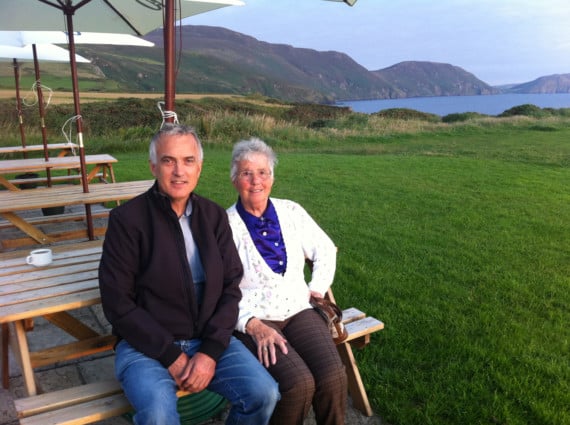
That’s the view of Clive and Hazel Teare. Clive’s mother Joan Teare-Corrin has dementia.
They are calling for pressure to be applied to the government to address this inequity as quickly as possible.
Mrs Teare-Corrin is cared for in the secure, NHS, specialist EMI unit at Thie Meanagh at Farmhill.




Although 87, she is physically unwell only because of the dementia, ’without which she would still be out on the golf course’ said Mr Teare.
The issue of funding has recently come to a head as she must be moved to a general nursing unit at Salisbury Street Nursing home in Douglas, which is private and will cost £925 a week, which is a very normal fee for 24-hour nursing care.
Mr Teare said he asked the Department of Health and Social Care (DHSC): ’’What happens then when the money (Joan’s) runs out, which it will in 2020. Are relatives expected to stump up their own cash?" Even with Joan’s teacher’s pension, old age pension and a top-up from the state there will be a £120 a week disparity.
’The DSC simply had the attitude that, "I’m sure it will be okay on the day" so I said: "That is not satisfactory".’
He added: ’We are questioning how the whole system works. She has a health issue. Dementia is an illness.
’The staff at Thie Meanagh are excellent but Joan has a disease that requires specialist care in an institution. She is in Thie Meanagh, cared for by NHS nurses, her specialist is an NHS neurologist, she takes drugs prescribed by the NHS. She is, in effect, hospitalised yet this is classed as "social care" and has to be self-funded.
’Compare this to someone with any other mental disorder and the state would pay. Someone with anorexia nervosa might be sent to a residential unit in the UK and stay there two years with the Manx NHS picking up the bill. A prisoner who has committed crime won’t be expected to pay for "social care" yet is incarcerated the same as Joan is incarcerated. Someone with cancer requiring palliative care in hospital won’t pay for social care.
’Where does the NHS "free at the point of delivery" promise end in the convenient gap between funding almost any other illness and funding dementia care?’
He called on government ’to end this iniquitous system’.
’It should either be that everyone pays or nobody pays. At the moment it seems that nobody pays except dementia victims.’
In correspondence with the Teare family, the department acknowledged there is an inequity and said it is the same in the UK. The Alzheimer’s Society calls it the "dementia tax" because dementia patients have paid tax and contributed towards the NHS but when they become ill in later life they are paying out again to cover costs of care, whereas other long-term conditions like cancer or heart disease are treated free.
In November 2016 the mental health service established a working party on the issue and it is under discussion at the department.
A Tynwald select committee appointed in November 2015 investigated the feasibility of introducing a dedicated compulsory contribution scheme for those under a certain age, in order to build a fund to provide for the future costs of their long-term care in residential accommodation.
The department is to produce a final report ’probably’ in July next year.
Mr Teare said: ’The government has realised there is a problem and are talking about it but it’s all going very slowly.
’Dementia is a horrible disease without having years of tax and national insurance ignored.’
Mr Teare added: ’The cases I have seen in specialist units are truly incarcerated against their will.
’They don’t choose to go in to residential care, they are tricked or forced into an EMI unit. In Joan’s case she had to be physically locked away for her own safety. Patients constantly try to escape but given their lack of cognitive function they can be diverted if they try it. The staff deserve a sainthood for the care that they deliver.’
The Department of Health and Social Care said arrangements for older people within its residential care service and who have a dementia diagnosis are the same as for other older people, in that residents are required to contribute towards the costs of their care if they are able to do so. The DHSC currently has 60 dementia care and support beds.
Older people with physical conditions or chronic illnesses are equally required to pay for their residential care.
Those patients and many others living with dementia in the Isle of Man receive a wide range of care, treatment and support from the DHSC adult services, community services and primary care as well as from the private and voluntary sectors.
The 2016 Isle of Man Census indicates there are about 1,300 people living with dementia in the island.
Comments
This article has no comments yet. Be the first to leave a comment.