

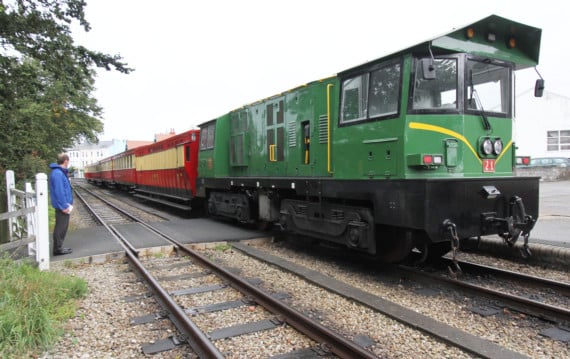
A diesel loco that has been plagued by technical problems ever since it arrived in 2013 and had been consigned to the depot since 2015, is pulling passenger trains at last.
Reporter Adrian Darbyshire took a ride.
Some passengers waiting at Port Erin railway station for the 7.45am commuter service were clearly a little disappointed.
One mum told her children: ’It’s not a nice steam train, it’s a horrible dirty diesel.’



Others, though, cameras in hand, were clearly delighted by the unfamiliar sight of no.21 pulling into the platform.
Driver Paul Pressley invited us on board.
So what’s she liked to drive? Paul said: ’Very easy. It’s all on the one joystick.
’You’ve got buttons for forward, neutral and reverse, a dead man’s switch which you have to press every five seconds, sanders and a whistle.
’To go forward you push it forward and if want to put the brakes on, you pull back on the lever.
’There’s no issues so far, she’s still got a few teething problems as she was stood for so long but we are working through them.’
Paul admits it is not as much fun as driving a steam train, ’especially when you are doing those diners by yourself’.
But there are some clear benefits - ’no early starts, no cleaning’.
Indeed, No.21 comes into its own for the commuter train.
A crew would normally have to come into work for 3am to fire up a steam loco.
The diesel starts at the turn of a key.
Our commuter train picked up passengers at most stations up to Ballasalla and had some 50 to 60 on board by the time we reached Douglas - proving just how popular the service is with office workers and those who simply enjoy a relaxing breakfast.
Latest figures showed a near-50% increase in passenger numbers on the Steam Railway between March and July this year, with 99,755 carried compared to 66,596 for the same period last year.
The green machine was purchased at a cost of £420,000 to pull commuter, dining and maintenance trains as well as acting as a shunter and recovery loco.
Paul doesn’t believe the dining train is a good option. ’It’s the steam engine that makes it romantic when you are on the diner.
’I think it will be used on the Pie and Mash trains which is near enough a normal service run, and on commuters like this.
’It might take up the slack when steam trains go out of service.
’Maybe the first service train in the morning, put the steam train in the middle, take the weight off the steamers a bit.’
Chief engineer Andy Cowie said no.21 has already come to the rescue after an injector failed on a steam loco.
It was other way round back in 2015, when in scenes straight out of Thomas the Tank Engine, the diesel had to be rescued by a steam train after it broke down while pulling a Valentine’s Massacre Murder Mystery special.
Some £246,800 has been spent on getting the diesel fixed.
Mr Cowie said: ’We’ve given it some comprehensive testing.
’There were a few issues but all the teething problems have been sorted out now.’
Rolling stock manager Mark Quayle has overseen no.21’s repair and return to traffic over the last two years.
He’s clear about the reasons for the problems that dogged that machine after delivery.
’This was a one-off and it was never really finished,’ he said.
The problems with over-heating, for example, were down to the cowling around the radiator.
’There wasn’t one,’ he said.
Trouble-shooting was like peeling an onion, he said, with more issues uncovered the more you investigated.
Fundamentally though, he maintained, there is ’not a lot wrong’ with the loco.
No.21 was originally due to be named Vignoles after the pioneering British railway engineer.
But Mr Cowie said that it never carried that name in service.
Instead, there’s a new name which is being kept under wraps until an official naming ceremony due to take place later this year.
Comments
This article has no comments yet. Be the first to leave a comment.