
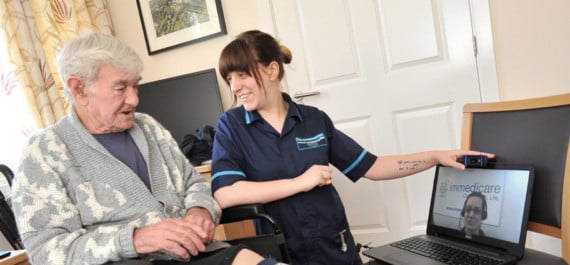
Residents in care homes will be able to see health professionals via video screens in a 12-month pilot project.
Health bosses hope the potential to significantly reduce the number of ambulance call outs and hospital admissions for older people, allowing care home residents to be assessed and treated where they live.
Called Immedicare, the service is a partnership between Airedale NHS Foundation Trust and technology company Involve, and is already in use in 500 care homes across the UK.
The scheme in the Isle of Man will have a three-month implementation period, to ensure systems and staff training are completed, before the pilot period begins.
-public-meetings.png?width=209&height=140&crop=209:145,smart&quality=75)
.jpeg?width=209&height=140&crop=209:145,smart&quality=75)
.jpeg?width=209&height=140&crop=209:145,smart&quality=75)

Immedicare will allow registered and specialist nurses, doctors and consultants in Airedale’s Digital Care Hub in Keighley, West Yorkshire, to view and assess patients directly in their care home.
They can then support the care home staff with decision-making and offer medical and other specialist advice.
The Department of Health and Social Care’s is currently exploring the ways that telemedicine and digital healthcare can improve the speed of access to services and make them more cost effective.
All of the care homes taking part on the island, both government-run and privately owned, have been provided with either a tablet or laptop device, linking them directly with the Immedicare Digital Care Hub via a secure video conferencing system.
This will be available 24 hours a day, every day of the year, with all calls to the service answered in a maximum of five minutes.
To make use of Immedicare, care home residents need to provide their consent.
* those cases where residents may lack the capacity to understand, families are asked to provide this where appropriate.
Officers from the DHSC have been visiting all of the participating care homes to inform residents of the service and answer questions they or their families may have.
The Digital Care Hub staff can also contact local services on the island such as ambulance in an emergency, the Manx Emergency Doctor Service (MEDS), community nursing, GP surgeries and hospice care when required.
The Digital Care Hub staff will monitor patient progress, providing follow-up calls to ensure the patient is stable.
Based on the experience of Immedicare in the UK, the scheme reduced emergency department attendances from care homes by up to 40 per cent, with a 25 per cent fall in the number of emergency admissions to hospital. Additional benefits included a reduction in the number of prescriptions issued because of ongoing patient monitoring, as well as up to a third fewer journeys by ambulance from care homes to hospital.
Experience also shows a substantial reduction in the amount of time GPs spend both at the care homes themselves and on the phone as a result of an out-of-hours call.
Minister for Health and Social Care Kate Beecroft MHK said: ’Looking at how we can improve care through the use of technology is an important element of the department’s five-year strategy.
’This is an exciting project and an example of the Department leveraging the power of telemedicine and digital healthcare to make services more responsive and convenient as well as more efficient.
’At a time when community and hospital services are under continuing pressure, this could bring real benefits for care home residents as well as the Department. Telemedicine means that patients can be assessed and monitored without having to be moved unnecessarily, or admitted to hospital.
’That means less stress for the patient and potentially less demand for some of the island’s health services.’
Immedicare’s managing director, Phil Parkinson, said: ’Our experience in telemedicine in a number of UK localities means that I am confident that this pilot scheme will show tangible and lasting benefits.
’And that is good news for all of the health and social care services affected by this change as well as, and most importantly, the residents and carers themselves.’
Immedicare is providing all the equipment, training and technical support for the duration of the pilot programme.
This digital healthcare project has progressed thanks in part to the generous support of the Henry Bloom Noble Healthcare Trust, which provided the funding for a one-year graduate telemedicine internship.
Comments
This article has no comments yet. Be the first to leave a comment.