
It’s the best job in the world, it teaches you what life is all about. What’s in those cots is the most precious thing, says Paul McCann, manager of the neonatal unit at Noble’s Hospital.
Reporter Julie Blackburn first visited the unit, then known as SCBU more than 20 years ago when it was at the ’old Noble’s’ in Westmoreland Road. Back then, the care was plainly outstanding but the staff were working in a facility that could best be described as ’basic’. Julie finds out that much has changed since then.
The Isle of Man, because of its geographical location, requires a unit that can look after babies that a similar sized hospital in the UK would not have the facilities or expertise to deal with. Fortunately, it now has exactly that.
The neonatal unit at Noble’s was previously known by its old name ’SCBU’, for Special Care Baby Unit. The name was changed in 2003 when the unit moved up to the new hospital and in 2015 a brand-new, purpose-built unit opened there, equipped to the highest standards.

.jpeg?width=209&height=140&crop=209:145,smart&quality=75)
The name ’neonatal’ reflects the fact that Paul and his team can offer not just special care but also the higher levels of care: intensive care and high dependency care.
Over here there is not the luxury of sending a sick baby by ambulance an hour up the road to the nearest specialist unit. Because of the risks involved with transporting a tiny premature baby by air it is only the ones who require neonatal or cardiac surgery who are sent across.
The average number of babies born in the island each year is 850 and the neonatal unit will receive approximately 150 of them. Paul and his team routinely look after babies born at 27 weeks (13 weeks premature) but have had babies born as early as 24 weeks surviving.
They work very closely with the maternity department, liaising with them on a daily basis. They keep the team apprised of mothers who have been admitted pre-term and are likely to deliver a premature baby. As soon as they are born there is a dedicated entrance into the neonatal unit from the labour ward so that the babies can go straight in and receive the care they need without delay.
The layout of the new unit was designed by the team with plenty of input from the parents of their tiny patients. Between them they appear to have thought of everything, down to the smallest detail, and have effectively future-proofed the unit for many years to come.
The cots are housed in two large rooms with the nursing station between them and large windows giving a clear view from one room right through to the other.
’Infection is the scariest thing we face,’ says Paul. Accordingly, there is plenty of space around each cot and the floor is colour-coded in ’pathways’, to mark a dedicated space around each baby.
Each cot is surrounded by a bank of equipment including a computer screen which can show the baby’s x-rays and scans.
Each also has its own, discrete lighting which can be dimmed or brightened as necessary.
There is also an isolation room for babies who acquire an infection and for babies returning to the island to be held in quarantine; a resus room built to the highest current UK standards, and a transport incubator on a trolley been specially designed to be wheeled straight onto an aircraft.
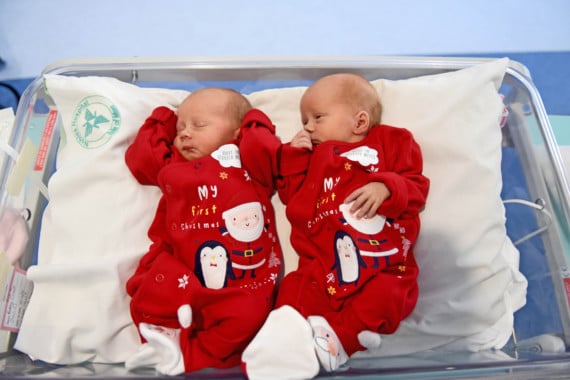
In the run up to Christmas five babies were admitted to the unit, including twins Lillie and Rosie. Lying in their cots in their tiny Christmas suits they look impossibly beautiful and healthy and it’s an image that epitomises the joy of the festive season.
Their parents, Samantha Crowe, 21, and Callum Simpson, 22, along with their elder sister, Georgie, two, are in the unit with them.
Samantha says the twin’s birth happened really fast. At just over 34 weeks she started having contractions: ’But it wasn’t like full blown labour yet but because it was twins they said they were bringing them now instead of waiting.’
She was given an epidural so she was aware of everything that was happening.
She recalls: ’I was in theatre for about an hour. It was quite good because they had told us they might have breathing problems but they came out breathing on their own so it was brilliant.’
Lillie came out first, followed just 39 seconds later by Rosie. When the twins first came into the unit, Samantha says: ’It all looked a bit scary. They weren’t properly feeding on their own, they would have one bottle then one feeding tube. That’s why they had to stay in here.’
Callum says: ’They’ve been amazing here. Everything looks so easy and comfortable because obviously, when you come in here, you panic when you see them hooked up to the machines and you can’t get to them. But then in just a few days they’re out of them.
’They were very surprised because they were so premature but they didn’t need oxygen or anything.’
Samantha adds: ’The care is brilliant, it’s absolutely fantastic. They’re all lovely in here.’
The twins have thrived. Lillie now weighs a healthy 5lb 1oz, with Rosie not far behind at 4lbs 11oz. They were scheduled to be sent home a few days before Christmas and Callum and Samantha were looking forward to having all their family altogether at their home in Ramsey.
This doesn’t mean, though, that the support has ended. The neonatal unit also runs an outreach service.
Paul McCann explains: ’That’s a wonderful thing that I was passionate about providing. Even if everything has gone well it’s daunting taking a new baby home, especially so when they’ve gone from being on a ventilator and dependent on drips.’
As babies leave the unit, new ones will be arriving and the team had been made aware there were likely to be more babies coming in before New Year so the care will continue seamlessly:
As Paul says: ’The service goes on morning, noon and night. I’ve got a wonderful team.’
Comments
This article has no comments yet. Be the first to leave a comment.