

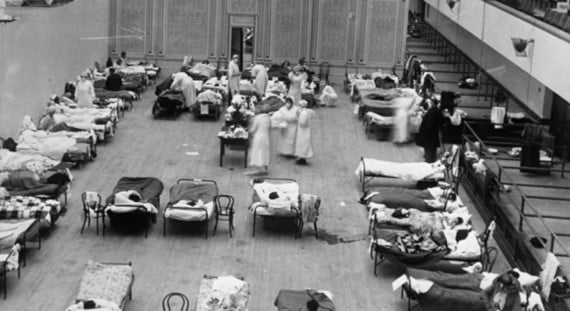
In February 22, 1919, the Lieutenant Governor and Local Government Board issued an order outlining a raft of restrictions on the townsfolk of Peel.
No performances were to take place in cinemas and theatres; churches, chapels, day and Sunday schools were to remain for closed; and no gatherings of more than 12 people could take place in private houses, school buildings, halls and hotels.
It all sounds chillingly familiar in these Covid crisis days.
For these restrictions were issued to deal with a feared second wave of the last major pandemic to strike the island, the so-called Spanish flu outbreak that arrived here towards the end of the First World War.
.jpeg?width=209&height=140&crop=209:145,smart&quality=75)


.jpeg?width=209&height=140&crop=209:145,smart&quality=75)
The strain of influenza became known as Spanish flu as neutral Spain was the only country giving it much coverage due to wartime press censorship.
While the epidemic was raging in England, the island had first been visited by a milder form of the disease as the Examiner of July 20, 1918 noted: ’Influenza of the Spanish variety had been rife in Douglas during the week.
’Large numbers of people have been seized and temporarily laid aside. Happily, the effects of the malady, though extremely unpleasant, have not in the generality of cases been serious and recoveries have as a rule been rapid.’
The Examiner reported that there had been a run on chemists’ shops for ammoniated quinine, eucalyptus and other remedies. ’Many people have pinned their faith to whisky, which in these days constitutes a somewhat expensive method of treatment,’ it added.
By the beginning of 1919, however, matters had taken a serious turn with a more virulent form of the disease spreading in ’rather an alarming manner within the past few weeks,’ the Ramsey Courier reported on January 17.
It pointed the finger of blame at prisoners interned at Knockaloe who were said to have imported it here after being transferred from a camp in England. Some 200 internees had been transferred in mid-December from four work camps across.
Peel City Guardian reported on January 18: ’It is thought that the present outbreak was imported into the island by alien prisoners of war, a number of whom were removed from a camp in England to Knockaloe a short time ago.’
The Ramsey Courier said it was given to understand that 28 people had died in the past fortnight from influenza, or from pneumonia following flu.
Children were sent home from school, dances and social events were prohibited and workshops, factories, railway carriages and public conveniences had to be disinfected daily.
The Lieutenant Governor first issued a proclamation on January 11 with a view to preventing and guarding against the spread of the disease.
Anyone wilfully violating the regulations was liable to a penalty not exceeding £20.
The public were advised to avoided crowded places, ’especially dances, parties and similar forms of entertainment’.
They should keep doors and windows open, and sleep in well-ventilated bedrooms.
Sharing towels should be avoided. Telephone mouthpieces should be disinfected.
Brush teeth frequently and use antiseptic gargles, they were advised. ’If headache, shivering or joint pains are felt, go to bed immediately and consult a doctor. Strict isolation should be enforced in every affected case.’
A new order was made on January 22 restricting the hours of cinemas and dance halls.
On January 24, the Ramsey Courier reported a growing numbers of fatalities.
It noted: ’The mortality recorded for the week was heavy, reaching at one period seven deaths in 36 hours.
’On Sunday there were no less than six interments in the Borough Cemetery, among them being two sisters, aged 22 and 17 years, who had fallen victims to the plague. Miss Christian K. Gelling, who lives at 16 Allen Street, died on Wednesday, and her sister, Miss Ruby Gelling, a few hours later, while other inmates of the house are also ill.
’Among the victims on Sunday was Mrs Gell, widow of the late Robt. Gell, builder, of Douglas, and sister of Councillor Quirk. She died on Sunday morning, just before the funeral of her son-in-law, Mr Charles Parkinson.
’Reports are current of whole families being affected who are unable to obtain any assistance in the way of nursing while all the medical men are as busy as it is possible for them to be.’
The Isle of Man Times on January 25 reported: ’On Saturday, the four-year-old child of Mr Jas. Kinley, Hatfield Grove, Douglas, a Naval Reserve man, who was home on leave, died from influenza. On the following day his wife died, while Kinley himself, while being removed to the hospital in the ambulance on Tuesday, died before he reached that institution. Three young children are as a consequence left orphans. Mr Kinley’s eldest son is serving in the army in France.
’There were four deaths in Douglas on Monday due to influenza, and since the epidemic commenced over 30 deaths were recorded up to last Saturday.
’This is a very large percentage in an island where the average death rate is about 14 per 1,000 of the population. The returns for the current week are not yet made up, but we are given to understand that no improvement is expected.’
A letter in the paper written by Alf Teare suggested that the government should acquire the old hospital at the top of Crellin’s Hill for the purposes of an influenza isolation ward.
He wrote that this would ’reduce to a degree the spread of infection through the lack of convenience for isolation which exists in so many working class homes.’
In the event Douglas Corporation offered its isolation hospital for that purpose.
However, by early February, the Isle of Man Weekly Times was reporting that the peak of the epidemic was over - but that it had claimed the lives of 50 people.
It reported: ’The influenza epidemic which swept over the island during the past month or so appears to have either run its course or to have been effectually stamped out by the measures adopted by the authorities.
’The epidemic has been by far the most fatal that has visited the island for a considerable number of years but all the regulations made by the authorities have been loyally obeyed.’
Of the 50 deaths, 26 were registered in Douglas, six in Peel, two in Foxdale, two in Ramsey and one in Castletown.
On February 22, the Examiner reported a recurrence of the influezna epidemic in the western district of the island, and as a result the Peel schools had been closed down.
’In other parts of the island, too, the scourge has again gained a hold,’ it said. ’The Local Government Board are contemplating strong measures with a view to combating the epidemic.’
But the renewed outbreak was not as serious as feared with only one death in Peel, albeit sadly that of a child.
On March 8, the Peel City Guardian carried criticism of the Local Government Board’s ’ill-considered, panic legislation’, pointing out the News of World had headlines about a ’Disease-ridden island’.
By March 29, the Examiner reported the island’s death toll from Spanish flu at 84, including 18 from that month and by April 5, Peel City Guardian said the total had risen to 88.
Across the world the epidemic claimed the lives of millions, making it one the deadliest pandemics in history.