

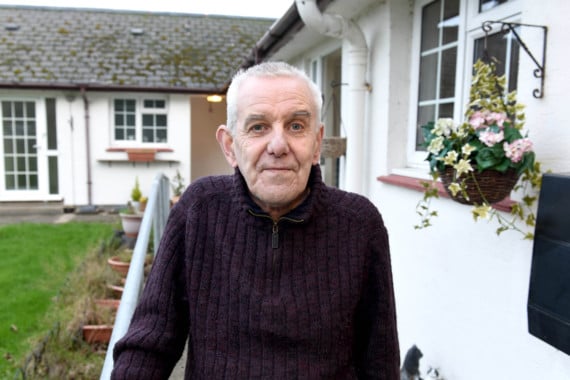
Questions asked by a Kirk Michael pensioner have prompted health chiefs to clarify their current policy with regard to the treatment of Age Related Macular Degeneration (AMD).
John McLaughlan wrote to Minister David Ashford asking him to explain what was going on.
Mr McLaughlan, who is 69, said: ’In September 2018 I read an article in the newspapers in which David Ashford stated that patients would not need to travel to the UK for procedures relating to AMD.
’I was relieved when I read this as I am a full time carer to my disabled wife and I was worried that I would not be able to get cover for someone to look after her if I had to travel to Liverpool.’




AMD is a common condition that affects the middle part of a person’s vision. It usually first affects people in their 50s and 60s.
There are two types: Dry AMD for which there is no treatment and Wet AMD which is treated with regular eye injections.
These are usually given every one or two months for as long as necessary.
John said: ’In December 2018 I was informed by the consultant at Noble’s eye clinic that the AMD had deteriorated and he would have to refer me to Liverpool to see a specialist in this field.
’I asked him why I had to travel to the UK when I was under the impression that patients could be treated at Noble’s, but I never got a proper explanation regarding this.’
John’s wife, Irene, who is 72, has had several strokes and a small heart attack.
Carer
She is also on medication for Parkinson’s which means she’s not even allowed to go into the kitchen to make a cup of tea.
John said: ’I do everything in the house and home care comes in once a day to wash and dress her. The last time she went into the kitchen to lift the kettle she dropped it.’
For him, having to spend a day travelling to the UK means having to find someone suitable to look after Irene.
’But I’ve got to go otherwise I’m going to go blind,’ he said.
Earlier this month John received a phone call from Aintree Hospital in Liverpool asking him to attend an appointment at the beginning of February to see the specialist.
John said: ’I explained my situation and the fact that I couldn’t get cover for someone to look after my disabled wife.
’I asked if it was possible to be seen by the team when they came over to Noble’s. I was told that the specialist had to see me in Liverpool, I was then given another appointment for the beginning of March to give me time to try to arrange cover for my wife.’
John then wrote to Mr Ashford explaining his situation and asking: ’Why do I have to travel to Liverpool to spend most of the day there to get a procedure done that is being carried out at Noble’s?
’This procedure takes approximately 20 minutes yet I’m being asked to travel to the UK.
’Why can he not find a specialist consultant in AMD to work at Noble’s?’
Since then, John has received good news, as he explained: ’At lunch time today I received a letter from Aintree Hospital to say that I have an appointment at Noble’s Hospital on February 1, so common sense has prevailed in the end.’
The Examiner contacted the DHSC and we understand from government sources that there has had to be a postponement to the plan to treat all AMD patients in the Isle of Man.
This has come about because the AMD service was put out to tender last year in order to provide treatment locally, but the successful organisation subsequently decided not to progress.
As an interim measure the department has renegotiated the contract with Aintree but the aim is to progressively increase the percentage of patients seen and treated on island.
Comments
This article has no comments yet. Be the first to leave a comment.