
Parkinson’s Disease Society Isle of Man is holding and awareness week starting tomorrow.
There are thought to be more than 300 Parkinson’s sufferers in the island and around 20 million worldwide but many of us know little about the disease.
Julie Blackburn has been finding out more.
It’s tricky to pin down a disease as complex as Parkinson’s. Its complexities and contradictions are best summed up in a booklet produced by the Parkinon’s Disease Society called called ’My grandad has Parkinson’s’, which imagines a conversation with a grandfather explaining the disease to his young grandson.
.jpeg?width=209&height=140&crop=209:145,smart&quality=75)


.jpeg?width=209&height=140&crop=209:145,smart&quality=75)
He tells him: ’Parkinson’s is something that affects my brain and it means I have problems controlling and moving my body.
’But it doesn’t affect me every day. Some days I can do things and some days I can’t. And I never know how I’ll feel from day to day. It affects everyone who has it differently.’
One of the myths about Parkinson’s is that it’s a disease of old age. While it’s true that most people who are diagnosed will be 50 years old or older, younger people, sometimes a lot younger, can get it too.
Its first signs are so subtle that it is thought that many people have the disease for years before being diagnosed.
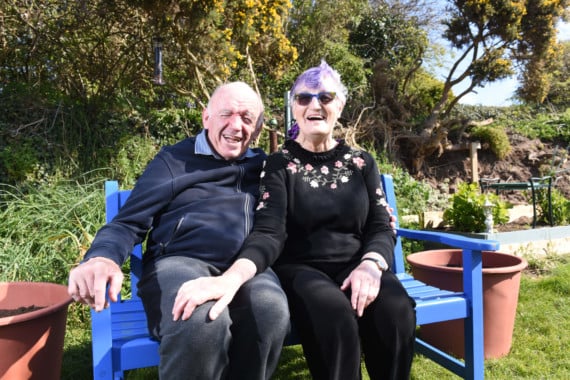
For Rob Farrer, who lives in Peel, he had the first inklings that something was wrong 12 years ago when he was 53. A painter and decorator by profession, one day he noticed that he could no longer reach his arms up above his head to paint a coving.
For Rob, it came as no surprise: his mother had suffered from Parkinson’s so he knew the signs, even the vague ones, and he knew straightaway what was wrong.
At first he tried to hide it.
’That’s what men do. They cover up the symptoms,’ he says.
He wasn’t fooling his wife, Fenella, who recalls: ’He used to hold onto his right hand to stop me seeing the shakes.
’I knew for about a year [that something was wrong]. One night I was getting ready to go out with a friend and I just lost it. I let rip and told him how stupid he was being.
’When I came home later he said: "I rang the doctor".’
Rob is now 65 and Fenella, at 76, is his full-time carer. For Rob, the disease has progressed to the point where his speech and co-ordination are noticeably affected and although he is still able to walk short distances, his gait can appear odd.
’I have been accused of being drunk but the brain is still pretty keen and a lot of people don’t realise that,’ he says.
The long list of drugs Rob takes help to keep the symptoms at bay means that much of his life revolves around the administering of these. Fenella, who worked at the hospital as a healthcare assistant before she retired, was not daunted by this but it’s easy to imagine that other new carers might be.
She and Rob explain their daily routine. Rob says: ’My sleep patterns are very bad and I’m up at five o’clock in the morning taking medication. Then I have to get a shower or a wash down before my pump is fitted.’
Rob is one of only five people in the island to have a pump. It delivers a dopamine substitute throughout the day which, he says ’helps to keep me upright and coordinated’.
Fenella attachs the pump for him.
At around 8.30 each morning she inserts a fine needle into his back which will stay there during the day. A line from this is connected to the pump itself, which he wears around his neck. The drugs it delivers have enabled Rob to cut down on the number of tablets he was taking but there are still some to take at 8am and at lunchtime and he has an injection before he goes to bed.
’He’s better in the afternoons,’ says Fenella, ’because by then the drugs have had a chance to kick in.’
Rob is comparatively lucky in that he is still able to get out and about in Peel and he loves to go for a drink with his mates. Even so, for both him and Fenella, there is one lifeline that has been invaluable for both of them, as he explains: ’When I was diagnosed my first call was to the Parkinson’s Society on the island. I don’t know how we’d have gone on without their help.’
Fenella says: ’We’ve lost friends because, with something like this you just do, but we’ve made more friends within the Parkinson’s Society.’
Rob adds with a grin: ’We go out for meals and no one cares if you throw your food down your front!’
And, as Fenella points out, she and Rob are able to go out for meals together without the society’s support but anyone with Parkinson’s living alone might not be able to.
Pamela Shimwell Mayo is chairman of the Parkinson’s Disease Society Isle of Man and the person Rob called when he received his diagnosis.
The society is a registered Manx charity which she set up in 1989. Her first husband, Derrick, had Parkinson’s for 30 years and she has used her experience of caring for him to help other sufferers and their families.
She says: ’We are the support society for anyone on the Isle of Man who is diagnosed with Parkinson’s or who is caring for someone with Parkinson’s.
’We provide a listening ear and anyone can call me on 438878 if they are newly-diagnosed or caring for someone and they need to talk.
’We also get referrals from the Parkinson’s Disease nurse specialist, Sue Lawley, for help with the purchase of carephones and other specialist equipment.’
Pamela adds: ’We try not to say "no" to anybody but we are a completely voluntary organisation and we have to raise all the funds we need to help people on the island.’
Parkinson’s Disease Society Isle of Man also holds a monthly Drop-In on the fourth Tuesday of each month, with coffee, lunch and a talk, and a short session of chair-based exercises.
You can find more information, or learn how to make a donation or leave a legacy, at www.parkinsons.im.
Comments
This article has no comments yet. Be the first to leave a comment.