
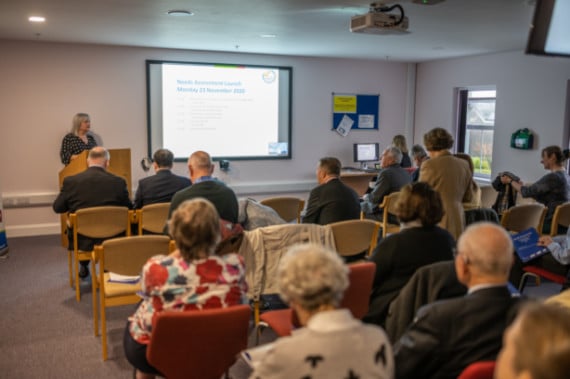
Health Minister David Ashford has formally launched the Hospice’s findings from its needs assessment report titled ’Integrated Palliative and End of Life Care for the Isle of Man 2020’.
The needs assessment, which aims to ’better understand and develop’ palliative and end-of-life care in the island, was undertaken by the Hospice’s Scholl Academic Centre - established in 2019 to carry out academic research for the charity.
The needs assessment is the ’evidence base’ for the work outlined in the Hospice’s five-year plan ’From Vision to Reality: The Island Plan for Integrated Palliative and End of Life Care 2018-2023’.
Also in attendance at the launch were the Lieutenant Governor, Sir Richard Gozney and the Chief Minister Howard Quayle.
.jpg?width=209&height=140&crop=209:145,smart&quality=75)


Over the last two years, Hospice’s researchers from the Scholl Academic Centre have brought together data from multiple sources to understand ’what is currently working well and what needs remain to be met’.
Looking at how many people in the island could benefit from palliative and end-of-life care, the assessment noted that the majority of people with cancer still die in Hospice, and that most people with dementia or neurodegenerative disease die in their nursing home, often with Hospice involvement.
Researching what people want from palliative and end-of-life care, the assessment found that: ’Most people, and the professionals who care for them, prefer that end-of-life care is delivered as far as possible at home.’
As for potential improvements, the assessment concluded: ’All staff involved in end of life care go "above and beyond" in their attempts to deliver an integrated service but the extra work this involves is not sustainable.
’The current system is complex with navigation and coordination difficult for patients and families; they would benefit from a designated keyworker.
’Carers feel that the essential role they play in coordination of care is not recognised by the services while, Third Sector groups also believe that their complementary role is not always acknowledged.
’Patients and carers face challenges, including off-Island care, and feel the need for more physical and emotional support.’
Talking about the launch Hospice Isle of Man chief executive and director of the Scholl Academic Centre Anne Mills said: ’The completion of the needs assessment is a significant milestone and achievement in helping us understand and meet people’s needs in our island.
’The ability for Hospice to offer greater choice relies on the development of a flexible integrated palliative and end-of-life care service, and I am so pleased the findings from this research will enable the new integrated palliative and end of life care delivery group to deliver services which meets the future needs of our island.
’For Hospice this academic research will allow us to develop and evaluate new models of integrated palliative and end of life care that better suits the needs of our patients and service users, giving them more choice in where they receive their Hospice influenced care.’
l The needs assessment was funded by a grant from Manx Lottery Trust. The full report is available at: hospice.org.im/NeedsAssessment