
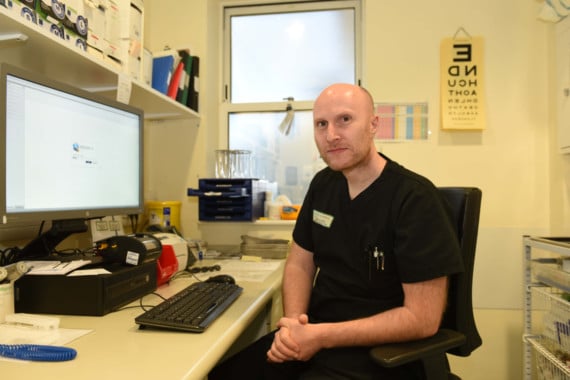
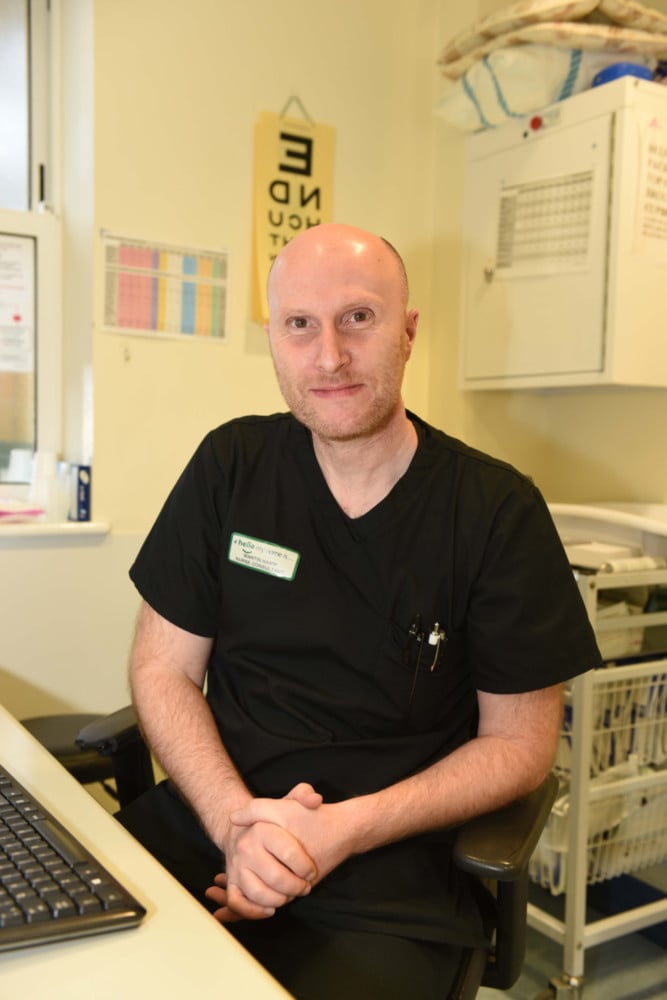
In the first of a series of articles examining various key roles in the DHSC Julie Blackburn talks to Martin Hamm, Nurse Consultant in the Emergency Department (ED) at Noble’s Hospital.
’We never know what’s coming in’ is probably the easiest way to sum up a day’s work for Martin and the team in the ED (formerly A&E or Accident and Emergency).
The morning I met him he had been supervising a nurse treating a hand injury and within five minutes he was dealing with a cardiac arrest.
’Part of the nature of working in the ED is that you expect a certain amount of change of pace, to be moving between minor injuries and very serious illnesses.’


After every major incident such as a cardiac arrest there is a debrief. That also goes for incidents when staff have been called upon to deal with violent behaviour or verbal abuse, usually when treating people who have drunk too much alcohol.
’Sometimes these patients are less than agreeable,’ says Martin wryly.
Martin himself has 27 years’ nursing experience but part of his consultant’s role is responsibility for less experienced members of the team.
The nurse consultant role came about as a UK initiative aimed at retaining the skills of senior clinical nursing staff in treating patients. Previously their only route to a higher grade meant going into management where those precious skills might be lost. Martin is the first and only nurse consultant on the island and his role is multi-faceted, as he explains: ’I see patients independently, clinically for 50% of my time. I have a caseload and full prescribing rights so I can request x-rays and bloods and do more or less what you would expect from a medic.
’There is also a research component, a strategic level component and a teaching component.’
Whenever a patient comes into the ED Martin would be as likely to see them as a doctor but his clinical role goes beyond that as he is part of a pilot scheme trialling outreach care that can prevent patients being admitted to the ED.
This has involved Martin going out to see and treat selected patients with a paramedic or in their homes. The cases are a selection of 999 calls deemed ’low accuity - not requiring a blue light ambulance to be there straight away.’
Martin carries a fairly big spread of drugs so for something like a chest infection he can administer antibiotics on the spot which may mean the patient does not need to go to hospital.
He goes on: ’They may still end up being admitted but, instead of coming through the ED, they are admitted straight to their speciality because they have already been assessed and referred.’
This clearly saves resources in the Emergency Department, can be more cost-effective, and can save patients, often elderly, a trip to hospital.
Case studies from the pilot have been very positive.
One involved a man living in the north of the island who had been discharged from hospital but was still poorly. Martin attended and realised he would need to be admitted:
’Under normal circumstance that patient would have been brought down to the ED and would have had a full work-up there, then be admitted to a ward before probably, at a later stage, being transferred to Ramsey Cottage Hospital.’
Martin was able to speak to the patient’s GP and have him admitted straight into Ramsey, saving an ambulance journey to the ED and time spent in Noble’s.
Another patient he was called to assess in the south of the island was an elderly gentleman man. A visit from Martin meant that this patient was able to remain in his own home with follow-up arranged from his GP.
The pilot scheme is part of the department’s review of the island’s Urgent Care Strategy: it is hoped to see this and other initiatives come to fruition in 2017.
The Emergency Department is also currently building two new clinical rooms and reorganising resources so that minor cases can be turned around much more quickly.
The run up to Christmas and, later, New Year’s Eve will bring the usual number of alcohol related cases into the ED.
Martin says: ’We always have extra staff on New Year’s Eve because we know we’re going to be hectic. But actually on Christmas Day we tend to get some very poorly patients in, for instance people with chest pains, who require input from several specialities and that can make us very busy.’
Martin’s message to everyone over Christmas and the New Year is a simple one:
’Have a good time, enjoy the festivities but do it within moderation and look after yourselves.’
Comments
This article has no comments yet. Be the first to leave a comment.