
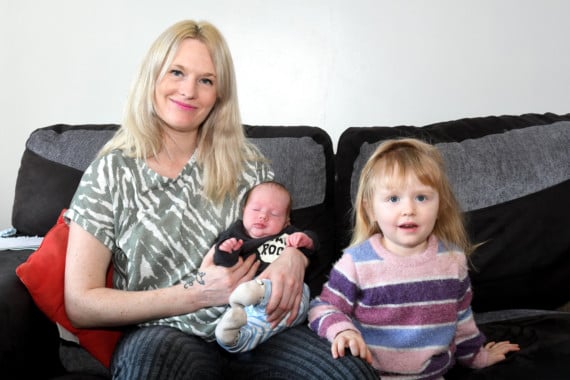
A mum from Douglas has undergone ground breaking fetal surgery in Brussels after her baby was found to have spina bifida.
When Joanne Crellin, 37, was given the diagnosis at her 20 week scan it was a huge shock as everything had appeared to be fine when she had her 12 week scan.
She says: ’[Noble’s] are not specialised in spina bifida: they can’t tell you much and what I was basically told was that he would be brain damaged and paralysed.’
Spina bifida is when a baby’s spine and spinal cord don’t develop properly in the womb, causing a gap in the spine. This leaves vital nerves exposed and, as the pregnancy progresses they can be damaged irreparably, leading to difficulties walking and changes to the brain which may require a series of operations to drain fluid from the brain (shunt placement) later in life.

Joanne was sent to the Fetal Medical Unit at Liverpool Women’s Hospital where all this was explained to her.
She was told that she might be able to have a new procedure, pioneered in the US and Belgium and first carried out in the UK in 2018, to close the defect in the spinal chord and prevent further damage.
She says: ’At first I wasn’t sure about having it but I went home and researched what the outcome was. Because in spina bifida the nerve endings are exposed on the spine, it’s the amniotic fluid around the baby that actually causes the damage and also, as the pregnancy progresses, the baby’s getting bigger so as the baby’s moving the nerve endings are pressed against you and getting more squashed.
’All the damage is done in the womb but the fetal surgery covers the exposed nerve endings so you can’t have further damage.’
Joanne had also been told that her baby had hydrocepahlus (fluid on the brain) and that helped her to make her decision.
She says: ’The biggest reason was I wanted to prevent him needing a shunt.’
In order to be eligible for the surgery Joanne had to undergo a whole series of tests and assessments with very little time in which to complete them as the operation has to be carried out before the 26th week of pregnancy.
These included genetic testing, a psychological assessment and an MRI scan which had to be carried out in London, where the surgery was also to take place.
And so began a whirlwind three months for Joanne.
Leaving two of her older children, John, 11, and Aalish, two, with her partner Shaun Ashmead and her mum, Susan Morling, (she also has a 19-year-old son, Corey) she packed her bag for what she expected to be an overnight stay and headed to London.
The hospital could not accommodate her so a friend, Gill Baker, put her up for the night.
Joanne recalls: ’Next day I was sitting in a cafe waiting for my MRI when the hospital rang me and said they already had someone booked in for surgery for the date I would have had to have mine so the only way for me to be able to have it done would be to go to Brussels.
’I asked them when I needed to go and they said: "Well you’ve got an appointment there tomorrow at 12 o’clock".’
As the enormity of this hit Joanne, all she could think of at first was: ’How on earth am I supposed to get to Brussels?’
Her friend Gill came to her rescue and booked her travel on the Eurostar and a hotel for the first two nights while she had more tests.
Joanne says: ’I was then in the hospital family room for two nights and then I had the surgery. At first they were finding things with his brain and they weren’t sure about having it done but then they said it was fine.’
Following the operation she stayed in hospital in Brussels for a week then flew back to Liverpool.
Because the surgery entails cutting into the womb, there is a possibility of rupture afterwards so Joanne was deemed a high risk pregnancy and advised to remain in Liverpool until she gave birth.
After two weeks in hospital there Joanne had to find a bed and breakfast to stay in for the next few months.
’The hardest part was being away from the kids,’ she says.
She was having scans every two weeks to monitor the pregnancy.
Because of the surgery she knew that she would not be allowed to go into established labour and would need a caesarian.
Her due date was January 18 but in early December they saw that her waters had broken and decided to deliver the baby there and then.
Her son Blay was born by caesarian section on December 6 at Liverpool Women’s Hospital. He was in intensive care there until December 10 when he was moved to Alder Hey.
That was when all the stops were pulled out to bring him and Joanne home to be with Shaun and her other children for Christmas.
She says: ’The hospital here was fantastic.
’They flew their staff from the Neonatal Unit over to Liverpool to pick up me and Blay because he was too little for a scheduled flight.
’They flew us all the way back here safely and they were absolutely wonderful.’
Now it’s a matter of waiting to see how successful the surgery was as Blay starts to grow but there is every reason to be hopeful.
Joanne says: ’They did say to me in Brussels that my surgery was an hour quicker than they’d done it before and they managed to get four layers sealed on him when usually they get three so they wouldn’t expect too many problems.
’He no longer has hydrocephalus and his cerebellum was pulled down but now it’s coming back into its proper position. You can’t tell if he will still need a shunt but I’m feeling positive that he won’t and he does have feeling in his legs apart from his feet.’
Recalling the three months she had to spend away from her family Joanne says: ’One thing that helped me through was all the people over here because I posted a lot on Facebook and the amount of support I had from all the people on the Isle of Man made me feel really proud to be from here.
’I never expected that much support and it just made you feel that if you were from a bigger area you probably wouldn’t get as much support in a way that feels as personal.’
She is also grateful to family and friends and others who supported her and the Isle of Man DHSC who have repaid all her travel and accommodation costs for her stay in the UK and Belgium.
She says: ’I wanted to do this [interview] to thank everyone that helped me.
’The second reason was so people would take their 20 week scan seriously, because people think of it more as a gender reveal, and the third reason was that if anyone else ever has this diagnosis I want them to know there’s someone they can go to.
’It can feel quite lonely and isolating to be told something like that and even afterwards you can’t really find much about it on the Isle of Man so it would be nice for people to know that I’m out there.
’Hopefully one day this will help somebody if they are in this situation and make it feel less of a blow.’
Comments
This article has no comments yet. Be the first to leave a comment.