
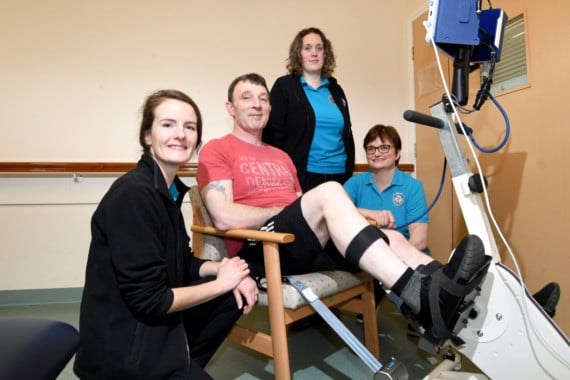
A ground-breaking ’bicycle’ which simulates muscle movements is helping a range of patients with long-term mobility problems caused by head or spinal injuries, stroke or MS. Julie Blackburn watched a demonstration.
One morning in April last year Jason Moffatt from Peel woke up with a headache.
And not just any normal headache, as he recalls: ’I don’t usually do headaches and this one was the worst: it felt like my head was about to explode out of the top.’
He put up with it for a while then decided it ’might be worth popping into the A&E’. It was lucky he did because an examination and subsequent scan revealed dried blood on his brain. He had suffered a bleed.
.jpeg?width=209&height=140&crop=209:145,smart&quality=75)

.jpeg?width=209&height=140&crop=209:145,smart&quality=75)
Jason was flown off the island to Walton Hospital in Liverpool for an operation but during surgery he suffered a stroke which left him paralysed down the left side of his body.
’I then spent three months in Liverpool, learning to walk again and do everyday tasks,’ he says.
While there, Jason realised that strokes do not just happen to older people, but to plenty of younger ones too.
Back on the island his rehabilitation programme has included sessions on a Functional Electrical Stimulation (FES) bicycle.
FES is a technique that uses low energy electrical pulses and has been found to be effective in restoring voluntary functions.
These pulses artificially generate body movements in specific muscle groups through electrodes placed on the patient’s body.
Jason’s physiotherapist is Christine Wright, from the Community Adult Therapy Services team. She specialises in helping patients with long-term neurological conditions and she demonstrated how the machine works.
Once the electrodes are positioned on the muscle groups which Jason needs to get working, he sits in a chair which is attached to the machine with his legs strapped onto the ’pedals’.
His session starts with a warm-up of around one and a half minutes before the resistance increases and he is working hard, concentrating on putting in more effort on his left leg.
Having started his treatments with around 10 to 15 minutes on the bike, Jason has now built up to 30 minutes in each session.
’I’ll be sweating at the end of this,’ he says.
As she keeps an eye on his progress, Christine explains: ’Although it’s a bike, the pattern of movement is simulating walking: each turn of the bike gives Jason a step.
’Numbers of repetitions lead to changes in the brain and the development of new neural pathways.
’The bike also strengthens the muscles so that, when those connections in the brain reform, those muscles are there, ready to be used.’
It has probably served Jason well that he was a keen cyclist before he became ill, having done the End2End mountain bike race, as well as the Parish Walk to Peel and the End to End walk.
He knows that he is also fortunate to have the use of the FES bicycle. When he was doing rehab in Liverpool, at a large, dedicated 30-bed rehab centre there, they didn’t have one: ’It was basically just a gym,’ he recalls. This is true of most rehab units where FES simulators are not part of the standard kit.
’We’re incredibly lucky to have this,’ Christine says.
This machine was purchased for the Community Physiotherapy Department two years ago with £11,695 provided by the Henry Bloom Noble Healthcare Trust.
The Trust’s main remit is to provide equipment over and above what the DHSC in the island would be able to buy.
It has been a great success for Christine and the other physiotherapists, Graihagh Betteridge and Rosie Callow, who are also trained to use the machine.
As well as working on patients’ lower limbs, the simulator can be detached from the bicycle element and used as a portable machine.
It can then be taken to people’s homes and used to help them regain shoulder and arm movement.
At the moment the department has to ration the machine’s use.
They take around 25 to 30 patients at a time, usually for a six-eight week course, with a session once a week on the bike.
They have a waiting list, both with new patients and patients who have had a course already and need further treatment. Because of this the Henry Bloom Noble Healthcare Trust has agreed to purchase a second bicycle so more patients will have the chance to use one.
Chairman of the Trust, Terry Groves, said: ’Jason’s story, and many others, have shown the value of this FES bicycle in managing differing conditions and rehabilitation.
’Recognising the continuing donations made to our Healthcare Trust we are delighted to fund the acquisition of this second FES bicycle from our funds so that continuing strides in this important area of aftercare can be made.’
Jason himself is delighted with the progress he has made using the bicycle: ’I can see an improvement. I can walk further and with a better balance,’ he says.
His aim now is to get back on his (real) bike.
Christine smiles when he says this. ’You will do it,’ she assures him.
Comments
This article has no comments yet. Be the first to leave a comment.