
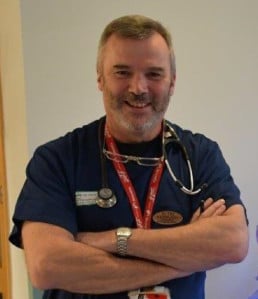
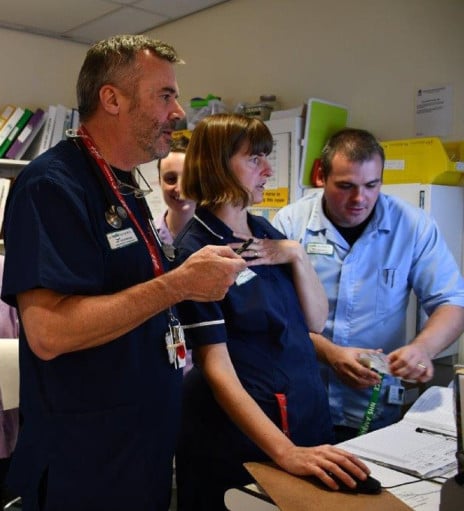
Julie Blackburn talks to Dr Tim Kerruish, interim medical director at Noble’s Hospital, following the publication of Sir Jonathan Michael’s report into health and social care services in the island.
The report contained the conclusions of an independent review by Sir Jonathan, a former consultant physician and chief executive of three UK NHS Foundation Trusts. It contains 26 recommendations primarily aimed at providing, and funding, a modern, fit for purpose health and care system for the island.
Now he has had time to study its findings, Dr Kerruish sees the report as essentially a positive step towards his own, very similar, aims.
He says: ’It highlights some of the areas that we need to pay attention to but I think it’s worth saying that lots of very positive changes were already underway when Sir Jonathan arrived, something which he acknowledges in his report.

.jpeg?width=209&height=140&crop=209:145,smart&quality=75)
.jpeg?width=209&height=140&crop=209:145,smart&quality=75)
’There were clearly problems, and they were well documented, and not only in the individual stories that we’d hear but also in the metrics of the hospital: long waits in the emergency department, long waits for outpatients, long waits for surgeries, so a big amount of effort gone into, essentially, modernising the way the hospital was running.
’We’re still at the beginning of the journey. We have this aspiration to be an exemplar rural and remote island hospital and to get there isn’t something you can turn around overnight.
’There’s an awful lot of hard work ahead and a lot of it is still starting to build the foundations for that. The number one foundation for that is picking up on Sir Jonathan’s report and putting patients and their families right at the centre of the care and that’s one of the most important things for us.’
This might seem an odd realisation, I suggest. Surely patients and their families should automatically be at the centre of the care?
Dr Kerruish explains: ’It’s a common criticism of struggling health systems that they lose sight of what they are actually there for. I think one of the most common distractions is that the system becomes obsessed with the finances and, instead of understanding what’s really driving costs, you get into cost cutting. I think it would be fair to say there’s been some of that here in the past.
’What the successful hospitals, when they transform, are able to do is to become a provider of safe, efficient, timely care and often that is in fact the cheapest.’
Interestingly, he tells me that one of the biggest drivers for hospital transformation in recent years has been (excusing the pun) the car industry.
’The American motor industry were paying for their employees’ health care and in the late 70s they could see how much of what it cost to produce a car was health care and they realised that, if that graph continued upwards, they would be unable to build cars.
’They looked at the health care providers and said: "You’re so inefficient - if we built a car they way you run a hospital we’d have no chance".
’So people started to look at Toyota in particular and how they build cars so efficiently. Toyota is a fantastic company in terms of efficiency and eliminating waste but what underpins this is the culture they’ve got that allows them to do that: it’s all about trusting the staff to get do it right and about having high performance, self-managing teams.
’The successful hospitals and health organisations, and other industries, have copied that model. That’s the core for us here too.’
When it comes to the progress that has already been made at the hospital Dr Kerruish says that there are already many very good departments.
’These include the emergency department, where the performance is really improving,’ he says.
’Despite increasing patient numbers the "four-hour" performance [the percentage of patients discharged or admitted to the hospital within four hours] is at a six-year high.’
The day I visited, despite the emergency department, being exceptionally busy with 130 people attending, 95% of them met the four-hour standard.
This is important because an emergency department is generally regarded as a barometer for the hospital as a whole. If it’s delivering a good performance that’s a very good sign.
One area where there has been certainly a perceived problem in the past is recruitment and it’s been well documented that Noble’s has been paying salaries to consultants that are significantly larger than those paid to counterparts in the UK.
Dr Kerruish says: ’My view is that we don’t need large numbers of people: we need relatively small numbers of exactly the right kind of person and I think it’s really important that we stick to a value-based recruiting policy for all our staff.
’We’ve tried the "we pay lots of money" route and obviously we’ve still struggled for recruitment and people don’t necessarily fully relocate here [when they come for the money].
’What we really want is people who don’t want to talk about the money: I want people who want to come here because they want to live and work somewhere beautiful and make a positive contribution and be part of the community. Our total consultant staff is less than 60 so we’re not looking for huge numbers of people, we’re just looking for exactly the right people.’
One of the visions for the future of health care in the island is the idea of a move away from trying to provide too much specialised care here.
Dr Kerruish explains: ’I think Sir Jonathan draws the picture that there are general things that we can do here really well but, because of the increasing specialisation, we can’t provide every service necessary here.
’There will always be a demand for something that we can’t provide, for example neurosurgery: we can never offer that here. It’s our job to make sure we can get people in the most timely way to the right services across and I do think that making it smoother to get patients and their families across and back is another piece of work we’re going to have to do.’
The future model, he goes on to say, will work on the basis of being more fully networked with larger hospitals in the north west of England that can provide whatever specialist care Noble’s can’t offer:
’We are really lucky because Liverpool has amazing tertiary services, for example the Walton Centre, and Alder Hey - which is a world-class children’s hospital: the facilities are there and it’s really providing patients and their families with a timely service and making those movements to and from the hospital as comfortable and as easy as possible.’
And Dr Kerruish concludes with a very honest ’progress report’ on the improvements being made at the Noble’s.
He says: ’We still have some way to go but with some green shoots of recovery starting to show.’
’the system becomes obsessed with the finances and, instead of understanding what’s really driving costs, you get into cost cutting’
Comments
This article has no comments yet. Be the first to leave a comment.