
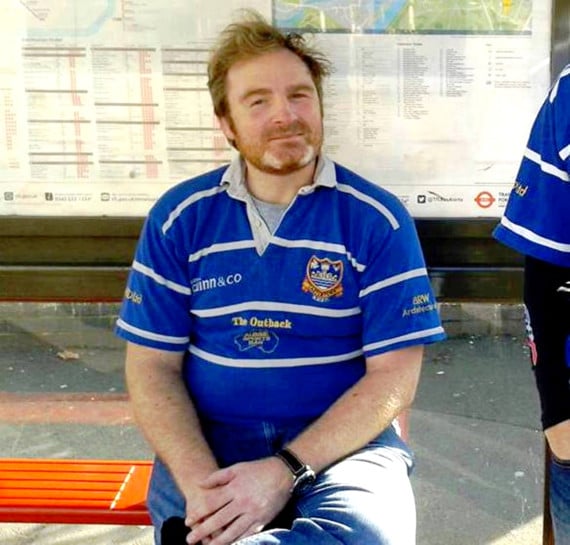
Health chiefs have admitted liability over the tragic death of a teacher and rugby club stalwart at the age of just 39.
Chris Scott, a teacher at Bunscoill Rhumsaa and former skipper and chairman of Castletown Rugby Club, died on October 8 last year after losing his battle against cancer.
Mr Scott, of Union Mills, left a wife, Heather and three young children, Jessica, Ellie and Reuben.
But a high court case has revealed negligence by staff at Noble’s had resulted in a year-long delay in giving him the correct diagnosis - and by then it was too late to save his life.




In May 2011, he had gone to see his GP Dr Gruffydd Evans at the Hailwood Medical Centre to seek his advice, among other matters, about a mole on his back.
His wife had noticed it two to three weeks earlier and it had changed in appearance and size.
Dr Evans referred him to Noble’s Hospital’s dermatology department by way of an urgent referral letter. But his patient had insisted he was never told this was an urgent appointment and he left the surgery without feeling anxious.
Then inexplicably, a consultant at the hospital downgraded the referral to a routine referral.
Even worse, the judgment notes, the hospital failed to inform either Dr Evans or Mr Scott of the downgrading and no appointment, urgent or routine, was sent to Mr Scott.
Nearly a year later Mr Scott felt it necessary to see another doctor at the surgery, Dr Hopkinson, about the mole.
Dr Hopkinson took urgent steps to refer Mr Scott to the hospital.
He was seen about four weeks later, on May 5 2012, when a diagnosis of malignant melanoma was made.
Unfortunately by this time it was too late and the cancer had spread. Nothing could be done to save Mr Scott’s life.
He had had a promising career ahead of him as a teacher, but retired on grounds of ill health in March 2015 and was only 39 when he passed away.
Now a court judgment shows that the Department of Health and Social Care has admitted liability for negligence and has agreed to pay compensation to Mr Scott’s estate.
damages
But it took a case to the high court seeking a contribution to the damages from Dr Evans, arguing he had breached his duty of care.
The DHSC also claimed Mr Scott himself had been guilty of contributory negligence for failing to make contact with his GP and Noble’s dermatology department when he heard nothing more from the hospital.
In his judgment, Deemster Andrew Corlett said he was left with no alternative than to hold that Dr Evans was in breach of his duty of care to Mr Scott by keeping to himself the urgency of the referral and not mentioning the risk of cancer.
But it followed that Mr Scott was not guilty of contributory negligence since most of the allegations against him in the department’s defence were predicated on the basis that he had been told of the urgency of the referral by Mr Evans.
He noted: ’This case is, in the true sense of an overused word, a tragic one.’
During the high court hearing, Deemster Corlett expressed surprise at the lengthy waiting lists for dermatology referrals, pointing out that waiting two years to see a consultant is self-evidently too long to have specialist treatment.
He also raised concerns that there appears to be no system for bringing the fact of an ’urgent’ referral to the notice of a patient’s GP.
The size of damages to be awarded will be determined at a future hearing.
Comments
This article has no comments yet. Be the first to leave a comment.