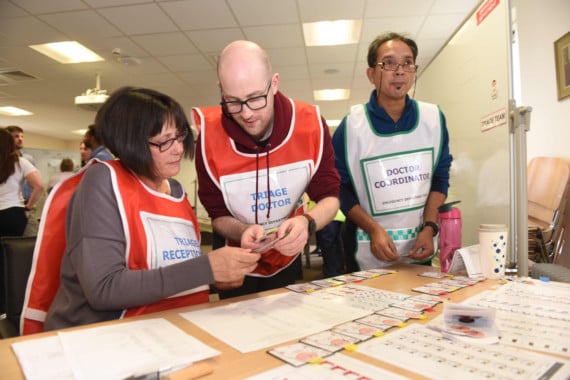
Staff across Noble’s Hospital were put to the test following the arrival of multiple casualties following an incident at Ronaldsway.
Fortunately, the major incident was a simulated exercise for the hospital’s annual training day which was designed to stress-test procedures in place in the event of a large-scale emergency.
More than 150 staff took part in the event masterminded by Noble’s Emergency Department consultant Dr Gareth Davies and emergency department colleague, nurse consultant Martin Hamm.
Dr Gareth Davies said: ’Major incident planning days are hugely important to ensure our readiness to deal with incidents which would stretch us to the limit.

.jpeg?width=209&height=140&crop=209:145,smart&quality=75)
.jpeg?width=209&height=140&crop=209:145,smart&quality=75)
’The island feels very safe, but we must not lose sight of the possibility we could be faced with a serious emergency at any time.
’We have robust plans in place, but it’s essential we test them on a regular basis and make any adaptations needed.
’We broke new ground this time in testing how community mental health services would respond to such an incident, both on the day and in the aftermath.’
He added: ’Staff gave their all to the challenge, which included some unexpected ’injects’, such as breakdowns and shortages - thrown in to make the exercise more difficult still, and to encourage teams to think their way through problems.
’I was extremely impressed at the commitment, professionalism and capability displayed by so many busy people. I am confident we are in good shape to provide safe, effective and compassionate care to patients and their relatives at a distressing time, should the unexpected happen.’
Participants included doctors, nurses, theatre and intensive care specialists along with laboratory, diagnostic and mortuary staff. Porters, catering, housekeeping, reception and admin staff were added, as well as a virtual media centre and reception for relatives. Senior clinical staff, emergency service officers and hospital managers oversaw the operation.
The Emergo emergency planning kit was used. Its components provide miniature virtual patients, allowing planners to allocate injuries and immediate needs to reflect likely casualties.
Staff liaised with other teams to organise their treatment and care and later gave feedback.
Comments
This article has no comments yet. Be the first to leave a comment.