
Making healthy food options cheaper than processed ready-meals.
And encouraging commuters to walk or cycle to work by making parking close to the office difficult or expensive.
These are among some of the ideas being put forward to tackle the island’s growing obesity ’epidemic’.
Official government statistics say that a quarter of children in the island are overweight or obese at the age of five, as are two thirds of adults.




It can lead to lifelong health problems and emotional and behavioural problems.
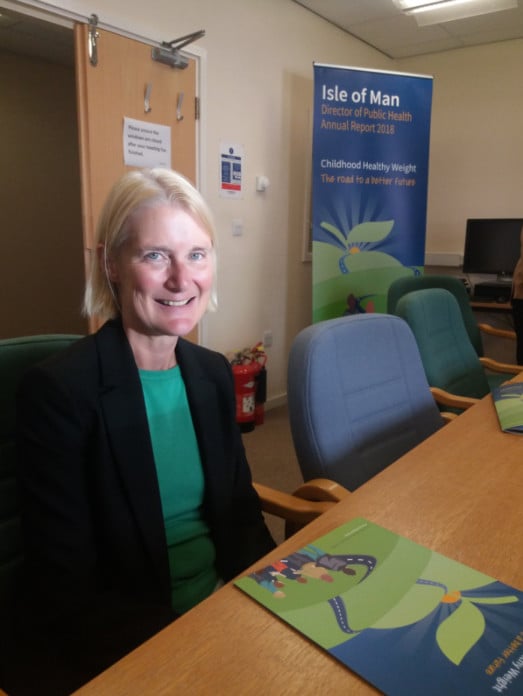
In her second annual report, public health director Dr Henrietta Ewart has set out a road to a better future to tackle this issue, which she describes as ’one of our greatest public challenges’.
Dr Ewart said it was a problem facing the entire world. ’It’s not just the rich world, even developing countries are beginning to see this,’ she said.
The old ’will power’ model was not working, she said.
She said: ’The model going back 30 or 40 years was that if you give people enough education and helpful advice on what a healthy diet is, then they will follow it.
’But the evidence overwhelmingly is that just giving people advice is not enough to change behaviour. ’
What society needs to do, she said, is to change the food environment to make the healthy choice the easy choice.
Dr Ewart said a lot could be learned from public health’s experience with smoking and the measures taken to deal with its availability, affordability and attractiveness.
’Tobacco products used to be very affordable, there were big adverts for Marlboro Man and it was cool, you saw film stars smoking,’ she said.
’Now cigarettes are expensive, they are behind a screen in the shop and you have to ask for them and they are no longer portrayed as cool.’
Dr Ewart said high calorie, high fat, high salt, high sugar products are attractively packaged as special offers. Calorie for calorie, those products are far cheaper than fresh fruit and vegetables and unprocessed food.
Obesity levels are higher in low income families who face particular challenges in following a healthy diet.
She said a multi-pronged approach is needed. This could include working with food retailers and outlets to promote cooking healthy meals on low budgets and improving the quality of food offered in schools and hospitals.
But it could also include measures to cut the cost of those healthier ingredients.
’We need to look at how we can make things cheaper for them,’ she said.
wonky
The public health director cites the example of some retailers now offering ’wonky’ fruit and veg, which would otherwise have been thrown away because they are smaller or misshapen. She suggests these could be offered at a discount.
Action is needed to control the density of fast food outlets, particularly near schools, her report says.
It includes a diagram showing the number of fast food outlets within an 800m radius of each of the island’s high schools. There are 20 near Ramsey Grammar School, 19 by Ballakermeen, 15 by Castle Rushen High School and 13 near Queen Elizabeth II High School.
Dr Ewart said we have all become much more sedentary and it is perfectly possible, to walk only a few steps in a day - from the house to the car and then into the office where you can sit at your desk for eight hours.
’All the natural activity has long gone and we need to try to get it back,’ she said.
The Manx government is drawing up plans for an active travel scheme to encourage more people to be physically active as part of their daily routine.
Dr Ewart said: ’With journeys of necessity to the shops, to work, to school we need to make it easier, more attractive to do it on foot or by bike. We need to change the environment, make it more pleasant and safer to cycle or walk.’
suggestion
One suggestion, she said, is to make it more difficult or expensive to park near your place of work. Commuters could be incentivised to park on the outskirts of town and walk in or hire a bike.
Dr Ewart said all this couldn’t be done by the DHSC alone. ’Arguably we have quite a small role. It’s got to be cross-government.’
She accepted there will be those who will not support the strategy as they believe it’s the ’Nanny State gone mad’.
Others will say that it will hammer those who can least afford it.
’That’s a risk,’ she accepted. ’What has been seen very clearly is that the message about education tends to work with higher income groups. There is a risk of widening the divide.’
A meeting, headed by Health and Social Care Minister David Ashford is scheduled for the end of September with a commitment to take a strategy forward, hopefully by the end of the year.
Comments
This article has no comments yet. Be the first to leave a comment.