
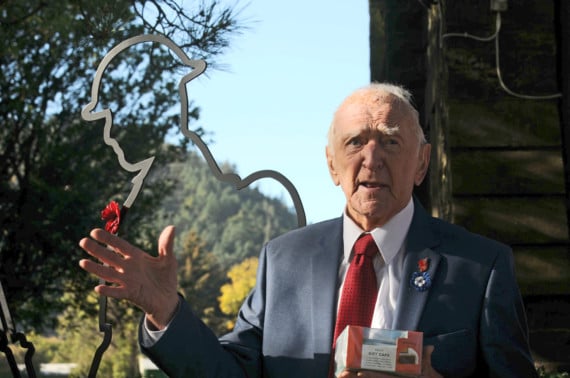
Hector’s calm and friendly eyes greet me when opening the door to his cosy home in Onchan.
’It’s just another day,’ he tells me when I ask him how he feels about turning 99.
’When you’re young you appreciate your birthdays.’
Born in the year 1919, Hector was raised in Sulby with four other siblings - one of whom tragically died at a young age.

Reflecting on his ’wonderful’ childhood days in Sulby, he tells me how he and his friends and siblings would make their own amusement such as hoops, yo-yos and concerts.
’I used to cycle with the boys from Sulby to Laxey, a wonderful place for pancake day,’ he shared with a grin on his face.
’Everybody in Sulby knew everybody. Mothers in all the houses had enough food to go through the winter and would put eggs in preservatives and make jams.
’There were no Chinese, Indian or other take-outs in our days. We had to make our own food and we lived very, very well.’
He added: ’We helped everybody and everybody was willing to help everyone else.’
At the tender age of eight, Hector and his family were informed of the death of their father, who was a deep sea diver.
The family had to make do with the single earnings brought in by their mother who was working as a housekeeper for a wealthy family.
’When I was 15 I went onto the ships where I sailed for two to three years. I then got appendicitis,’ he said. ’After I was treated my mother said "come home and build yourself up".
’I went back to the island, but I didn’t want to sit around and not do anything.’
There was a twinkle in his eyes while he spoke fondly about his brief time working for the Isle of Man Railway, which gave him the opportunity to see the different areas of the island.
He said: ’I was getting myself ready to go back to sea when the war started.’
Soon Hector was put on the register to take part in the Second World War. He had high hopes of getting into the Navy but went straight into the infantry with the Lancashire Fusiliers in May 1939.
Not wanting to stay in the infantry, he changed career and started working in the tank corps in North Africa - taking part in the Allied invasion of Salerno in Italy.
’When you’re in a tank and suddenly start to go into action you think "my God this is terrible".
’I would start praying and the guy sitting above me would whack me on the head saying "wake up!".
’It’s an awful noise, I think that’s why my ears are all ruined now because we didn’t have ear muffs like you do today for chainsaws.’
He explained that while working in the tank corps they were promised they would be home in time for Christmas in 1943.
’We didn’t get home until January 1944,’ he said.
After his leave, Hector was given his next briefing to Normandy on June 6, 1944 - a day that went down in history as ’D-Day’.
Hector said that he and the men didn’t know what to expect.
’When we landed in Normandy we were going through the men laying and floating dead in the water.
’The Normandy landings are now inscribed into my memory. I’ll never, ever forget it.
’I was no better on the day I went into battle than the last day. I was just so frightened. I was saying my prayers every day and I’m sure that if I hadn’t have been I wouldn’t be here today.’
He took part in the fight all through France, Belgium and Germany until they reached Hamburg on the first week of May 1945.
He said: ’We weren’t to fire at anybody unless they fired first. There were talks that Hitler had committed suicide. Two days after the war finished we were sorting the German sectors and put people into various occupations to rebuild Germany.
’What a wonderful thing! Germany was rebuilt and it was rebuilt beautifully.’
Following the war, Hector joined the police force back in the island and later became a driving instructor and examiner for 17 years.
’I enjoyed that,’ he said. ’But my wife, Gladys, said: "It’s about time to lie back and take it easy now".’
Still eager to contribute towards his community and others, he joined the Joint Ex-Service Association (JESA) and a number of other organisations dedicated towards preserving the memory of the war in which he fought.
Hector has visited schools around the island hundreds of times to share his experiences and explain why it is important to remember the 12,000 Manx men and more who were killed as a consequence of the war.
He also encourages high schools to get involved in the Spirit of Normandy, Young Historian Project competition.
It was because of his tireless efforts with the island’s schools he was awarded a British Empire Medal in 2013 and Tynwald Honour in 2014.
Hector says he never expects anything for his efforts and he is genuinely delighted and humbled by any form of appreciation.
’I’m here to tell what happened and to pass them on,’ he said.
’We’re depending on those children now to do something to take over.’
He adds that he has no doubt that the next generations of children will do well in this.
’It’s amazing the questions they ask you,’ he said.
However, Hector feels strongly that more could be done to recognise and pay respects to the Manx men who lost their lives in the Second World War.
’I would like to have a memorial garden for them and there is plenty of room in St John’s,’ he said. ’That is the one thing I would like to see before I pass.’
As of yesterday, Hector spent part of his birthday unveiling a Tommy silhouette at his old primary school in Sulby before enjoying a meal with his two sons and other family members at Milntown in Ramsey where a surprise party was held afterwards.
After the interview I got a hug from Hector. It struck me that a man who’d witnessed such harrowing things, could be so warm-hearted and open.
He didn’t let those awful things he saw make him into a bitter person. Instead he chose to share about his experiences in a healthy, constructive way so that I and others may hear about them today.
Comments
This article has no comments yet. Be the first to leave a comment.