

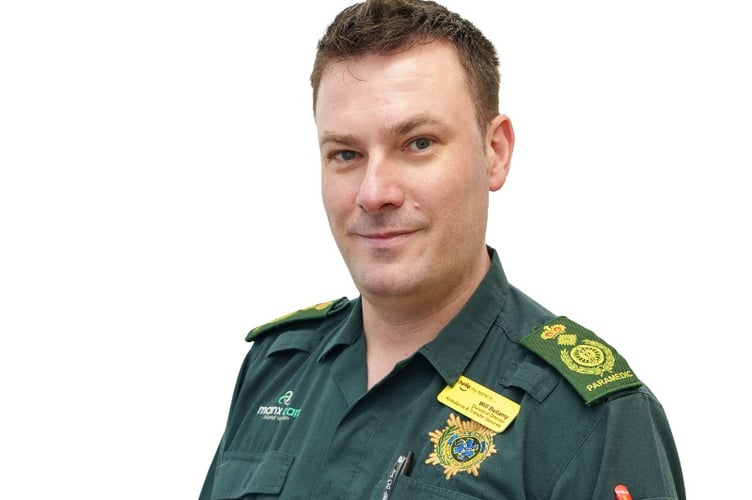
With thousands of visitors set to arrive and more than 50,000 people potentially needing medical support during the racing fortnight, the Ambulance and Transfer Division is already deep into its final preparations, planning that, as Divisional Director Will Bellamy explains, begins the moment the chequered flag falls on the previous year’s event.
‘Our TT planning for this year started at the end of last year’s event,’ he said.
‘We’ll look at what went well in 2025, what didn’t go so well, and what we can refine, and then start to build that into making any changes ready for the Manx Grand Prix in August and then continue that planning all the way through.’
.jpeg?width=209&height=140&crop=209:145,smart&quality=75)

.jpeg?width=209&height=140&crop=209:145,smart&quality=75)

That continuous cycle of review and refinement feeds into months of operational planning, from staffing and equipment to positioning ambulances across the island’s challenging road network, something Mr Bellamy says is central to delivering a safe and effective response during racing conditions.
‘The island geography is quite interesting, and the road network is only one way over the mountain,’ he said.
‘We have to put additional resources in to make sure we can get a timely response to Ramsey, to the west of the island, to the south.’
During TT, large parts of the course become inaccessible at times due to racing, meaning emergency response planning must account for road closures, diversions and restricted access areas such as Kirk Michael, Glen Helen and parts of Ramsey.
Mr Bellamy said the Ambulance Service works closely with Manx Road Racing Medical Services (MRMS), who provide trackside care for racing incidents, while Manx Care’s statutory ambulance service remains responsible for the wider public and all non-race emergencies.
‘Our role is to support them in a catastrophic incident, but also we are the statutory emergency ambulance service for the population,’ he said. ‘If people need access to healthcare during TT, whether it’s a race, practice, or not, phone 999 and we will make plans to get to you.’
Behind the scenes, preparations also include detailed staffing arrangements and mutual aid support from the UK.
This year, Manx Care will again be supported by South East Coast Ambulance Service clinicians, alongside additional assistance from Great North Air Ambulance Service, which will provide a critical care car operating daily during TT.
GNAAS has been delivering life-saving critical care support on the Isle of Man since 2022, and it’s been confirmed as the official Charity Partner for the TT and Classic TT events in 2026.
Ordinarily, the island runs five ambulances during the day and three at night, but this increases significantly during TT, with up to eight vehicles on duty across the 24-hour period at peak times.
Mr Bellamy said that while external support remains important, the service has also strengthened its own workforce.
‘We’ve had a really successful recruitment process of employing our own paramedics,’ he said. ‘We had our first two paramedics we trained on Island graduate in March this year.’
That investment in training and staffing is part of a wider effort to ensure resilience during what is effectively a surge event for the health service.
-(2).jpeg?width=752&height=500&crop=752:500)
Manx Care board papers have described TT as the busiest period of the year for hospital and emergency services, with preparations also including a pre-TT discharge event aimed at increasing inpatient capacity ahead of the influx of visitors.
The organisation has also recently cancelled elective procedures due to very high demand, underlining the pressure placed on services even before racing begins.
Mr Bellamy said every part of the ambulance service, from paramedics and technicians to emergency care assistants, control room staff and operational support teams, plays a role in keeping the Island moving safely.
‘It’s not just about paramedics,’ he said. ‘Everybody that our clinicians see patients over this fortnight are seeing people, and supporting those clinicians in front of patients.’
Alongside operational planning, significant focus is also placed on staff wellbeing and psychological support, particularly given the intensity and high-pressure nature of TT responses.
Mr Bellamy said the service has developed structured systems including peer support networks and formal debrief processes.
‘We’ve really put in place trauma risk incident management peer networks to support colleagues,’ he said.
‘There’s nothing better than having a cup of tea in the crew room and talking through what’s happened and processing it.’
He said hot debriefs immediately after incidents and follow-up reviews also help staff reflect and recover, alongside wider mental health support systems.
‘We have to consider how we support that mental health element,’ he said. ‘We’re all in this together, regardless of what uniform you wear, just being a decent human being and supporting each other.’
Despite the intensity of the fortnight, Mr Bellamy said there is still time to appreciate the unique atmosphere of the TT, even for those working on the frontline.
‘You cannot not enjoy the TT,’ he said. ‘Whether you’re on the prom, at the Grandstand or in Peel, Port Erin or Ramsey, it’s a fantastic atmosphere.’
For Mr Bellamy, who began his career as a paramedic in 2004 and was awarded the King’s Ambulance Medal in the New Year Honours earlier this year, the role remains deeply personal.
‘I still feel like a paramedic,’ he said. ‘Ultimately I’m just the custodian of the service, and I want to make sure we provide exquisite care, we’re quick to get to you, and we’re doing some really great things here on the island.’