
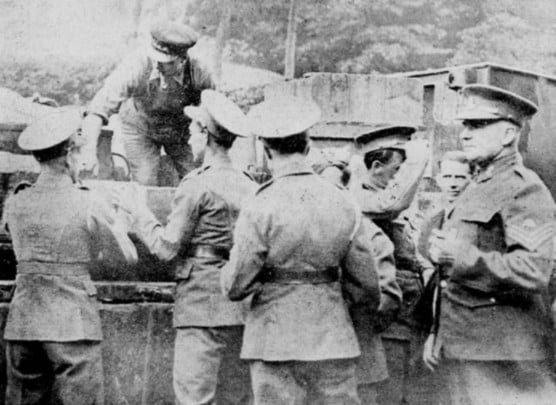
The 80th anniversary of the start of the Second World War is today.
On September 3, 1939, France and Great Britain declared war on Germany after the Third Reich invaded Poland.
But preparations began well before that.
At 9am on Friday, August 25, a group of Manxmen left the island for Liverpool at the beginning of what for many of them would be six years of absence from their homeland.
-(1).jpeg?width=209&height=140&crop=209:145,smart&quality=75)
They were the men of the 15th (Isle of Man) Light Anti-Aircraft Regiment, Royal Artillery - the Manx Regiment.
Most of the men were to see service in two continents and in more than ten countries.
Most would return home but some were to die and others would spend four years as prisoners of war.
The regiment had been formed almost exactly a year earlier as part of the British Army’s expansion as a precaution in view of the grim developments in Nazi Germany.
It would lose some 80 of its number during the forthcoming conflict.
Some of the regiment’s volunteers were veterans of the First World War. Others were the sons of veterans. A few of them had last seen their fathers when they went to war in 1914-18.
The regiment’s role as an anti-aircraft unit was a vital one; if war was to come their duty would be to defend key sites such as airfields, docks and factories using the Bofors guns and Vickers guns with which they had trained intensively for many months.
Call-up began on August 22 when the first handful of men were ordered to the drill hall in Peel Road in Douglas.
These were the men who would make the final detailed arrangements before the rest of the regiment was ordered to report for service.
Eighty years ago, in the days when urgent communication meant the use of a telegram, it would be a miracle if the message could be passed to every man in the space of a few hours but that miracle did indeed happen.
On Thursday, August 24, the order to mobilise was received in the island at lunchtime. It was immediately distributed by messengers who travelled all over the island in cars and on motorcycles while in Douglas loudspeaker announcements were made.
All afternoon the island’s young men flocked in hastily-donned uniform to the drill hall where final checks were made of their equipment.
During the afternoon and evening growing crowds of well-wishers assembled around the drill hall. There were so many that rope barriers had to be hastily erected and the police had to keep the traffic moving.
At 7pm the first men marched from the drill hall to Victoria Pier where the Steam Packet vessel Fenella awaited.
All through the evening men and equipment were embarked and as the boat filled up entertainment was provided by Jack Hart’s orchestra from the Palais de Danse, which played popular music and songs from the 1914-18 war.
By midnight almost every man had been contacted and had answered the call and 360 of them were preparing to spend an uncomfortable night aboard Fenella in preparation for her departure at 9am.
In the morning the gates of the Victoria Pier were opened by the Steam Packet Company so that families and friends could bid farewell to the men.
The boat pulled out into the bay the strains of the Manx national anthem. The regiment’s immediate destination was Liverpool but, at the time, where they would go from there was anybody’s guess.
Their first war station would be in Liverpool where they were to defend the vital docks from enemy attack.
From here they would go on to defend England’s south coast during the dark days of 1940 and the Battle of Britain. At the end of 1940 they were shipped to North Africa.
The story of the Manx Regiment is told in the Regimental Museum, which forms part of the Manx Aviation and Military Museum at the airport.
It is open daily from 10am.
Comments
This article has no comments yet. Be the first to leave a comment.