
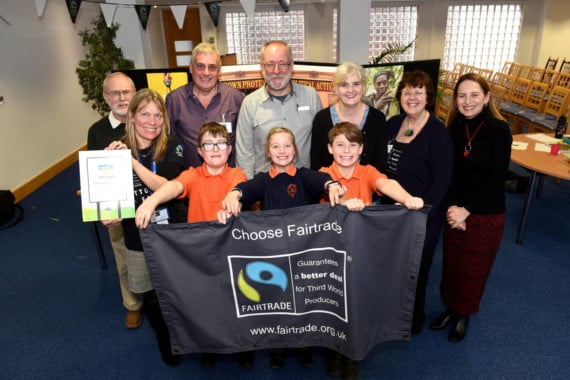
The island is to remain a Fairtrade country for another two years.
The news was announced at an annual Fairtrade conference where about 70 schoolchildren from the island took part in workshops, ate plenty of ethically-sourced chocolate and carried out hard-hitting debates at the legislative building in Douglas.
To be granted this status, the island needs to reach certain goals, such as having a number of shops that sell Fairtrade goods as well as promoting local suppliers.
initiative
.png?width=209&height=140&crop=209:145,smart&quality=75)

.jpeg?width=209&height=140&crop=209:145,smart&quality=75)
Organised by the One World Centre, Bruce Crowther MBE, the founder of the Fairtrade Town initiative, was invited to speak about the importance of knowing where our goods come from.
Mr Crowther was ’instrumental’ in the island gaining its first Fairtrade status in 2008, Wendy Shimmin, co-ordinator of the OWC said.
Currently he runs a not-for-profit chocolate-making company called The Fig Tree, in Garstang, Lancashire.
Garstang became the world’s first Fairtrade Town in 2000. Today there are nearly 2,200 Fairtrade Towns, Cities and Islands across the globe.
The movement began with Mr Crowther, his wife and their babysitter.
’We wanted to change the world. We were sick of the fact that we live in a world where children are dying from poverty.
’In a world where there is so much money, so much richness and yet children were dying for a lack of sachet of salt,’ he said.
As part of the movement, the team looked to encourage better support for fair trade and local produce as ’the two go hand in hand’.
’In Garstang even, wealthy as it is, you had farmers down the road committing suicide because of the cost of a pint of milk,’ he explained.
’We eat the best Belgian chocolate, but we don’t think about the farmer who grew those beans. They don’t just grow the cocoa they do part of the process that makes that chocolate taste so good. We don’t credit them.’
The initiative was ’very difficult in the early days’, he said.
’The strength of the story - and this is what I was particularly wanted to share with the children - is that whenever things are really that hard you stick to what you believe,’ he continued.
A conference highlight for the campaigner was seeing the children debate in the Tynwald chamber.
’They were debating the issue "why are people rich" with "do people deserve to be rich" as the question. I struggle with that question,’ he said.
’I think kids have a really good sense of justice and fairness.
’Children need to be installed with that belief that they can change the world, that actually they can make a difference and to stay believing that to do the right thing is not always doing what the pressure of society often puts upon people.
’I don’t know what happens... but as people get older they seem to get more cynical.
’They somehow get conditioned in society and greed takes over.’ He added: ’Some of them put their hand up when they were asked by the President of Tynwald, Steve Rodan, if they wanted to be MHKs. It’s lovely to think they could be budding politicians.’
Jen Mordue, nine, from St Thomas’ primary school, in Douglas, said she would take away the importance of buying more Fairtrade products and helping the farmers.
’It might be a bit more but it’s worth that little bit more to help the farmers,’ she said.
Her schoolmate, Kyle Rosenbroek, nine, added: ’This is so they can send their children to school, buy clean water and more products to help them because they get only 26p a week.’
Comments
This article has no comments yet. Be the first to leave a comment.