

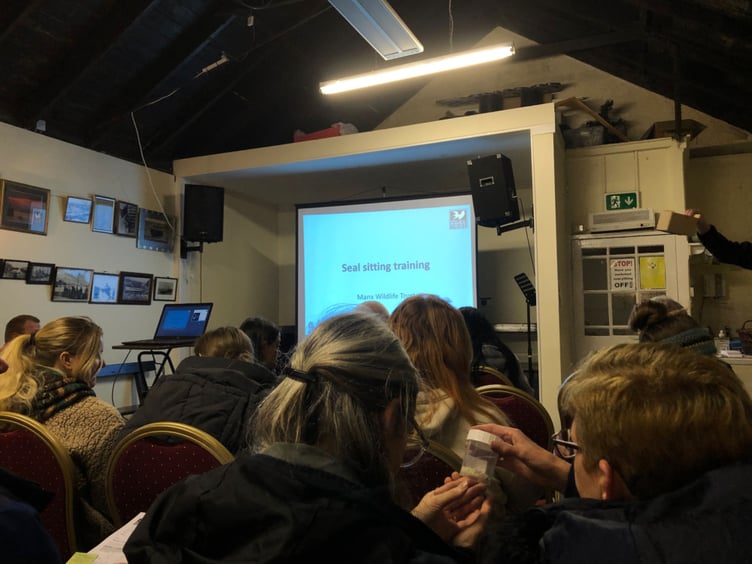
Members of the public were invited to find out more about ’seal sitting’ at a session in Peel hosted by Manx Wildlife Trust (MWT).
This follows the charity appealing for donations towards seal pup rehabilitation after there were reports of the mammals being touched or put back in the sea.
For seal sitting, volunteers would be expected to attend the sighting of a seal if it’s on land, ensure it’s not injured and deter others from approaching it.
Just over 20 people attended this session, the last of which was held the same time last year, to hear from Lara Howe, the marine conservation officer for MWT, on how to get involved in volunteering.
.jpg?width=209&height=140&crop=209:145,smart&quality=75)
.jpg?width=209&height=140&crop=209:145,smart&quality=75)
She started off by explaining why it’s important to keep an eye on seals that find themselves on land, saying seal pups aren’t often aware of the danger humans can pose.
Once a seal pup is interfered with, it faces the risk that its mother could abandon it if it sees this happening and feels threatened.
The reason seal pups will reside on land for a short time is to rest - so if someone were to think they were helping by putting a seal pup they mistook as ’stranded’ back into the sea, this would most likely kill the seal as it wouldn’t have enough energy to swim to safety.
Haul out sites are important not only for them to rest but also for them to have time to digest food, so disturbance at their haul out site can impact on seal fitness and breeding success.
Dr Howe said: ’It’s important to get more volunteers because people are busy and the more people we have, the less of an ask it is - if you’ve got 50 people and there’s 50 seals, that’s one trip whereas if you’ve got five people and 50 seals that becomes a lot more effort.
’Everyone’s been so supportive of this, it’s great to see.’
Dr Howe went on to give a lesson on how to identify different types of seal and distinguishing age.
We get two types of seals in Manx waters - the Atlantic and the common seal.
The Atlantic or grey seal appears all year round and has a bigger ’blubber’ layer whereas the common seal, which isn’t particularly common in the seal population and observed in small numbers, is lighter in colour and smaller and usually seen more in the summer months.
Both are very mobile and the Isle of Man is an important haul out and resting location for them.
These are protected under the Manx Wildlife Act 1990 which dictates that if they are disturbed, injured or killed the person involved will be guilty of an offence.
To identify the age of a seal, all you need to do is look at its coat.
If it’s white and fluffy it’s a new pup and within this is a number of stages.
Stages one to three span from zero to 15 days where the pup will remain white in colour but after day 16 it will begin to develop its grey coat. At 18 to 25 days it will become fully weaned.
Dr Howe stressed that though seals spend 80% of their time in water, they will often haul up to rest, sometimes on busy beaches, which is why volunteers are needed.
’This happens all year round but it tends to be busier in the autumn and winter just because that’s when the pups are born and it’s stormy conditions,’ she continued.
She then told volunteers how to tell if seals had been disturbed, adding: ’If they’re looking at you, you’ve already started disturbing them.
’But also be aware of making noises on approach.’
The marine conservation officer said lack of noise can be an issue, especially if you’re coming from the water rather than on land, so people in kayaks can cause seals a fright in some circumstances because they don’t hear them coming.
She said the key was keeping your distance so there would be minimal disturbance.
Finally, Dr Howe gave instructions of what to do when a volunteer goes seal sitting.
There will be a call to action via a WhatsApp group MWT has set up and they will discuss who can attend. The volunteer must ensure they wear suitable clothing and footwear, bring food and drink, keep their phone on them and know where access to the site is.
When they have located the seal they must:
- Assess the seal for injuries or illness
- If injured, call Dr Howe or the MSPCA
- If not injured, place up signs (provided by MWT at the meeting and on request) warning the public not to come near
- If possible, seal sit and speak to the public if necessary
In terms of injuries, seals will often have minor ones from fighting with other mammals but it’s only if something looks particularly serious that a volunteer should call MWT or MSPCA.
After the session, Dr Howe said the MWT didn’t have the funds to put GPS tags on seals in Manx waters to track and monitor them. She said: ’It’s very difficult to track the population of seals because we don’t know what they’re doing, they’re so mobile.’
She added the charity was still appealing for donations for rehabilitation facililities for seal pups that have been abandoned, saying: ’We’re a bit limited with what facilities we’ve got, we’d like a proper purpose built pond for them to swim in because that’s really important for their rehabilitation is their ability to become strong swimmers and things like that.’
Call the MWT office or email [email protected] for more information on becoming a seal sitter.
Comments
This article has no comments yet. Be the first to leave a comment.