
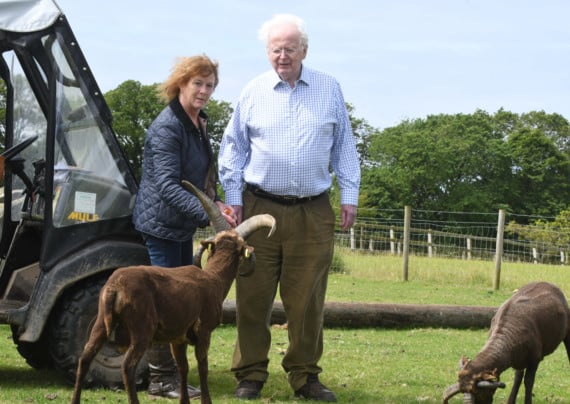
When you keep the largest flock of loaghtan sheep in the world, around 1,500, you have to care about the preservation of the breed and for Doug Bolton it’s no different.
Manx born and bred, his father was Sir John Bolton, the former chairman of the government’s finance board who played a prominent role in establishing the island as an offshore finance sector. Doug trained as an accountant and at one time had the biggest accountancy firm in the island.
When he bought White House Farm in Kirk Michael with 1,500 acres in the early 1970s, he had no farming experience. It was his first venture into agriculture.
’I bought the farm so I had to farm it,’ he says.
 Man showed picture of his genitals to teen he was mentoring on her first day in job
-(1).jpeg?width=209&height=140&crop=209:145,smart&quality=75) Fire crews respond to 11 incidents across the Isle of Man in a single day
Fire crews respond to 11 incidents across the Isle of Man in a single day.jpg?width=209&height=140&crop=209:145,smart&quality=75) Police found 41 vapes containing controlled drug hidden under man’s bed
Police found 41 vapes containing controlled drug hidden under man’s bed.png?width=209&height=140&crop=209:145,smart&quality=75) Just 6% of Isle of Man visa applicants required to provide criminal record checks
Just 6% of Isle of Man visa applicants required to provide criminal record checksDoug started with charolais cattle and sheep. The cattle were sold back into France which in those days brought its own challenges, because of Monetary Compensatory Amounts (MCAs) which were then in force. These were border measures in the EU which were abolished in 1993 with the advent of the Single Market.
Doug recalls: ’We had to fly them back to France, about 60 young cattle in a plane. The main reason for that was we couldn’t land them in England and take them through because of what they called an MCA which was £40 each if we took them through England so it just about at that time paid the air fare for them if we hired a plane. Going back over the years there’s been quite a few escapades and we had a lot of fun.’
Fortunately, Doug got rid of the Charolais before the advent of BSE in the 80s. At the time he already had some loaghtan sheep and a few Jacobs.
He says: ’I bought loaghtans in 1975 from Ivor Crowe who was down in Ballaugh. In those days there were very few loaghtans around and I had to persuade him to sell me two ewes and an old tupp - they were so old they all needed Zimmer frames.
’So I had them and gradually everything else disappeared and we ended up with [just] the loaghtans and the numbers have built up from there.’
Ably assisted by his shepherds, David and Lorraine Radcliffe, Doug’s loaghtans spend their lives happily roaming the parkland paddocks around White House Farm. When Lorraine goes to check them she usually has a packet of their favourite biscuits which they crowd round for.
Loaghtans are generally a low maintenance sheep. They are independent, resistant to blow fly strike and are not prone to foot problems. They can live for up to 15 to 20 years. They lamb easily and very rarely need any human assistance.
They are slow to mature and none of Doug’s sheep will go for meat until they are around two and a half years old.
This, he adds, caused a bit of a tussle with the EU about whether meat that old could still be called ’lamb’. This was finally resolved in the loaghtans’ favour and it may be the oldest meat officially approved by the EU as lamb.
Whilst we all love to see the traditional Manx loaghtans with their pale eyes and distinctive horns, for farmers a breed has to have a use and there has to be a demand for it to justify keeping them.
Alongside a wish to preserve the breed, Doug approaches it with a commercial mindset and he has a piece of advice for anyone farming on a smaller scale and trying to offer a premium product.
Because, as he points out, you have to keep them in large enough numbers to offer a consistent supply.
He says: ’It’s the old story when people ask: "Why have you got so many loaghtans?"
’You need the numbers: people with about five sheep say: "we can’t sell them" and I say: "Of course you can’t sell them" You sell what you’ve got and a weeks later they come for more and you say: "I’m terribly sorry I haven’t got any more till next year".
’If you haven’t got them you can’t sell them, that’s been my principle.’
He was delighted when Tracey Ridgway from Close Leece Farm came to him to buy Loaghtan meat for her award-winning Manx loaghtan Salami.
Doug recalls: ’She said to me: "How many can you supply us?" and I said: "How many do you want?"
During lockdown Close Leece also developed a range of frozen meals based on some of the dishes they serve in their café and meat from Doug’s loaghtans also goes into that.
’Tracey has developed a new market with her charcuterie: she has done a fantastic job,’ he says.
For him, a shoulder joint slow roasted (he suggests up to nine hours at 160 degrees with a slug of red) is the way to eat loaghtan meat. And whilst it may sound strange, even wrong to some, that is the way that we can continue to preserve rare native breeds like our Manx Loaghtans: keep on buying and eating it.
As Doug says, when you ask him about the future of his flock and Manx loaghtans as a breed: ’It depends whether people want them or not.’
Comments
This article has no comments yet. Be the first to leave a comment.