
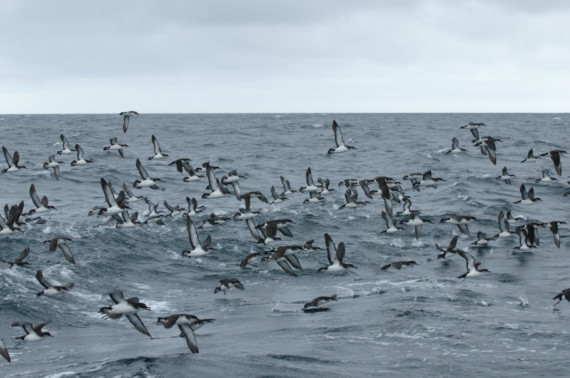
In this month’s Manx Wildlife Trust article, education officer Dawn Colley tells us about the work being carried out to protect Manx Shearwaters.
As the warm weather has arrived, we are heading out to enjoy our beaches and you can’t help but admire the many seabirds around our coasts.
These include wonderful birds such as the gannets, which can often be seen diving into the water after its prey at speeds of up to 60mph.
However, this month we are looking at a very iconic seabird which is capable of travelling huge distances.
.jpeg?width=209&height=140&crop=209:145,smart&quality=75)

.jpeg?width=209&height=140&crop=209:145,smart&quality=75)

The Manx Shearwater has had a long association with the Isle of Man and was originally known as the ’Manks Puffin’ in the 17th Century.
During that time, one of their strongholds was on the Calf of Man. However, the accidental introduction of the brown rat (known as long-tails) to the islet because of a shipwreck in 1781 caused a ’catastrophic’ decline and by the beginning of the 19th century, the shearwater colonies on the Calf were all but wiped out by the long tails predating on the chicks.
In 2012 the Manx Shearwater recovery project was started with a structured programme of baiting and monitoring long tails.
Although eradication has not been entirely successful, it has reduced the population sufficiently so that only one or two sightings of these creatures are made annually.
This has allowed the Manx Shearwater population to gain a substantial foothold along the east coast of the Calf and at a couple of more isolated sites on the west coast of the islet, which is exciting news.
Annual monitoring of these colonies is undertaken but, with Manx Shearwaters being nocturnal, this is a difficult task.
The good news is that we have received funding from the Curraghs Wildlife Trust to purchase a thermal imager, which will allow the Calf of Man bird wardens to monitor the activities of the shearwaters under the cover of darkness.
Here are some amazing facts about these incredible birds.
During the breeding season Manx Shearwaters commute between their colony and offshore feeding grounds and can sometimes travel up to 1,500 km during these feeding forays.
Manx Shearwaters feed on small fish, herring, sprats, and sand eels, which they catch off the sea surface or by pursuit diving.
The parent Manx Shearwaters incubate their single egg for 51 days, with the chick then remaining in the nesting burrow for a further 70 days where it is fed by both parents.
If you would like to find out more information about these birds and see a model of a nesting burrow, then we have a small exhibition at the Curraghs Wildlife Park in the discovery shed.
Also featured there is another of our projects, that of the diminutive pea mussel, which is kindly being supported by the Curraghs Wildlife Trust. There are one or two challenges for you to complete too.
This is a lovely example of how working in partnership we can have a more powerful impact on recovery of our wildlife.
If you would like to know more about the Manx Wildlife Trust’s work please check out our Facebook page or pop into our Nature Discovery Centres at Scarlett, the Ayres and in our shop at Peel, or visit mwt.im
Comments
This article has no comments yet. Be the first to leave a comment.