

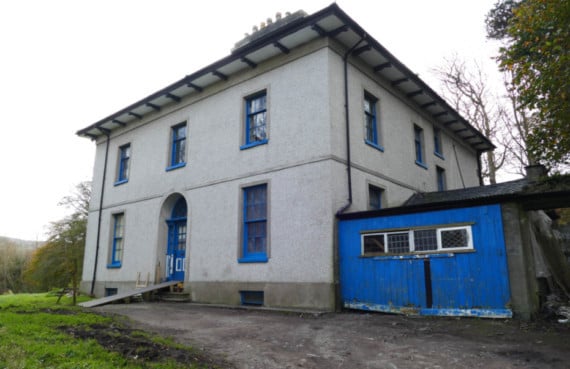
A derelict mansion house built for an MHK in the 1840s is due to be demolished.
Glenfaba House, built for Captain Cameron who was sworn in as an MHK in June 1848, is being flattened as part of plans for a new regional sewage treatment works for Peel.
Manx Utilities says that the condition of the building, after years of neglect, is too poor to retain even the facade.
But historic equipment, including an old water wheel, will be saved and removed for restoration.




Neighbours have been notified of the planned demolition, which will only take place after a notice has been granted by building control, typically six weeks from the date of application.
A planning application for the new regional sewage treatment works is expected to be submitted in a ’matter of weeks’, said Manx Utilities. Demolition does not require planning permission.
Glenfaba House was bought by the authority in 2017 for £600,000 from the beneficiary of the previous deceased owner’s estate.
Manx Utilities said demolition will allow construction of the new works to begin as soon as possible so it can be completed within the term of the current government administration. Following discussions with Manx National Heritage, a building survey company was engaged by Manx Utilities in 2018 to survey and record the house before its planned demolition.
’Their final report was issued very recently and will be provided to Manx National Heritage as a record of the property and placed in the public domain,’ a spokesman for the authority said.
’The water wheel on the site is believed to have provided hydro-electric power to the house which would have most likely been installed sometime prior to the 1950s.
’The water wheel will be removed to a place where its heritage can be better appreciated - we are working with interested parties to pass it into their care for restoration.’
The spokesman said that Manx Utilities had assessed the possible reuse of the building and the costs associated with refurbishing and stabilising it.
’Retaining the house was subsequently determined as not a practical proposition with the topography of the site in addition to the structural integrity of the building being compromised due to years of neglect,’ she said.
She said the proposal is to place the treatment units as far north into the site as possible and to place the control buildings to the western edge - furthest from the nearest adjacent properties and minimising sight of them from the road or heritage trail.
Landscaping, earth banking within the site and planting of many trees and low-height shrubs will further obscure any view of them, she said. The entrance road has been curved to the left inside the site to allow greater screening of the buildings.
The 1851 census lists Captain Ewan Cameron, aged 40, living at Glenfaba House with his Patrick-born wife Catherine, 39, son John and daughters Ann, Mary, Louisa and Isabella.
Spacious
Sister-in-law Margaret Bridson and governess Margaret Grafton and Mr Cameron’s niece Mary Jane McDonald were also staying at the house.
Staff recorded on the census, who probably lived in the spacious attic rooms, were nurse Theresa Weiland, gardener Edwin Patrick, house servants Flora Patrick, and Elizabeth Harrison, Ann Felt and William Dodds.
The 1861 census lists Mr Cameron as ’Captain in army (retired)’ , and now with an another daughter Jessie, aged four. The 1871 census gives his occupation as a magistrate and landowner.
By 1901 the house is owned by Captain William Nugent, aged 60, an Irishman with two daughters who had been born in India and a youngest third daughter born in Ireland.
Comments
This article has no comments yet. Be the first to leave a comment.