
Does the acronym ELSPAC mean anything to you?
If so, you are probably one of 800 parents who took part in a birth cohort study, which followed the families of children born in the Isle of Man in the early 1990s, writes Sue Woolley.
The European Longitudinal Study of Pregnancy and Childhood (of which the Isle of Man was a part) was a Europe-wide research initiative coordinated by Professor Jean Golding at the University of Bristol under the auspices of the World Health Organisation.
Data collection continued on the island until 2008.

.jpeg?width=209&height=140&crop=209:145,smart&quality=75)

Dr Stephanie Goodfellow and Edna Rolfe, who managed the Isle of Man study have both now retired and responsibility for looking after this valuable data has passed to the University of Bristol.
It will be held there by the Centre for Child and Adolescent Health, within the School of Social and Community Medicine, and managed by the Isle of Man Data Governance Committee.
Much research has already been published on the study and data collected in the Isle of Man has been contributing to an important DNA database covering the whole of the British Isles and Ireland by Professor Jim Wilson at the University of Edinburgh and Prof Gianpiero Cavalleri at the Royal College of Surgeons of Ireland in Dublin.
Results could potentially inform government policy and health interventions that target sub-groups of the population.
It is hoped that further research proposals will be written so other researchers can take full advantage of the wealth of information.
Barbara Corlett, who took part in the ELSPAC in the Isle of Man study, told us about her experiences as a study mum...
’It was more than 20 years ago when I first met Edna Rolfe (Neddy).
’She appeared one day at the start of an antenatal clinic at Ramsey Cottage Hospital, where I work as a staff nurse.
’She explained that she would like to enrol the pregnant mothers to take part in a longitudinal study to investigate the health and wellbeing of children.
’The study was to continue for seven years, with both parents and child (when they were old enough) filling out questionnaires. She made it sound quite simple, and was very enthusiastic.
’I found this fascinating, as before moving to my present position I had worked as a community staff nurse in Brixton, London.
’During this time I met all sorts of people in their homes, and it became very clear that our families, our surroundings, our diet and all sorts of factors have an effect on our health and wellbeing.
’I became passionate about preventing ill health if at all possible.
’This led me to train as a health visitor, as I was under the impression that this way I would be able to change the world for the better.
I discovered that this was a very naïve view as most of us find it quite difficult to change the habits of a lifetime, let alone listen to a stranger handing out what they feel is good advice.
’Nevertheless, on meeting Neddy I could see that if there was evidence to prove that children’s health is affected through poor housing, poor diet, poor loving, etc. it could show how we can improve the health of the nation, and maybe indicate where the government should be putting its resources.
’At every antenatal clinic Neddy would appear and chat to all the pregnant ladies in the waiting room, and was incredibly successful in enrolling nearly every mother to be. I was feeling quite left out until I discovered that I was pregnant with my third child, and then I suddenly found I was signed up as well!
’This was the beginning of seven years of questionnaires.
’I was amazed when I started filling out the first one, at the questions I was being asked. Had I moved house, got divorced, cried in the last day, week, or month? What did I eat? How big was my house?
’There were so many questions, which thankfully only needed a tick in a box. It was also good to know that whatever answers we put down would be anonymous, so we could be as honest as possible.
’In October 1991, I had a little girl, Emily, who weighed 9lb 9oz (4.12kg) so a rather large baby.
Thankfully, we had only one questionnaire each year.
Although they did take at least half an hour to fill in I was always fascinated by the questions which made me think twice about what I was feeding the family, the relationship with my husband and was I keeping in touch with friends and family? I was hoping I was being a good parent to Emily and my other children and that I was giving them the best possible start in life. The questionnaires were a reminder for me that maybe I could do better.
’When Emily was a little bigger she filled out her own questionnaires, and I would have loved to see what she filled in. She enjoyed the task and remembers the drawing and colouring.
’I was fortunate enough to be asked to help in collecting the data for the seven-year checks. This was a delight and privilege as I met many seven-year-olds in the study, who were extremely open about what their favourite things in life were, and how they viewed the world. It was an education in itself, and made me think of the saying "give me a child, and I’ll show you the man", as by seven one could see what sort of adults they would become - some quiet and shy, others bursting with confidence.
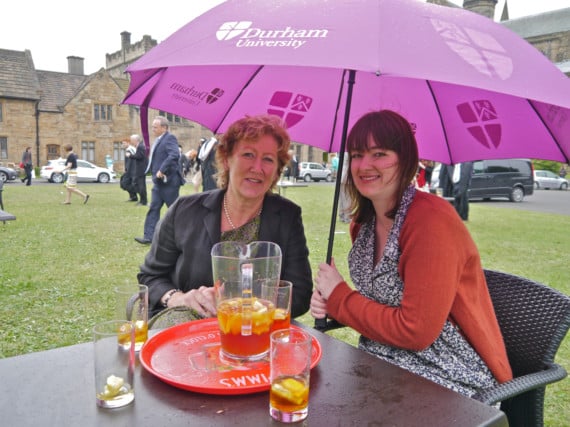
Emily is nearly 27. She graduated from Durham University with a degree in physics, followed with a masters degree and is now studying for a PhD.
So maybe she didn’t have too many chips or suffer from the bleach I sometimes put down the sink! At times I took a while to fill in my questionnaires, but I am so glad there will be a wealth of data for people in the future to study. It will be an evidence base to maybe improve the health of the nation for the better’.
Comments
This article has no comments yet. Be the first to leave a comment.