
Halloween, or Hop-Tu-Naa as we know it in the Isle of Man, is a time when we turn our minds to black cats.
Indeed, National Black Cat Day was on October 27 and it encouraged us to celebrate this colour of cat, not least because it is sometimes associated with bad luck.
Conversely, in many cultures black cats are associated with good luck and they are seen as a good omen - a black cat appearing on your doorstep signals prosperity (a common belief in Scotland), and a black cat crossing your path signals good fortune (in England and Ireland).
But in much of the western world black cats are considered to be harbingers of misfortune and wickedness, due in the main to their association with witches and Satan.


.jpeg?width=209&height=140&crop=209:145,smart&quality=75)

In the 17th century simply owning a black cat could lead to harsh punishments, even death, because of their association with witchcraft.
The black cat still suffers from, as the National Black Cat Day publicity calls it, the ’consequences of a damaged collective reputation’ which is why celebrating the black cat is a great opportunity to subvert trends and false beliefs.
Black cats could, themselves, do with some good luck.
They are two thirds less likely to be adopted than white cats, and fifty percent less likely to be adopted than tabbies.
They are also more likely to be involved in a road traffic accident because they are less visible to drivers.
Another reason given for black cats being overlooked when it comes to adoption is that they are difficult to photograph, but a shiny black cat can be very photogenic.
In fact, most black cats are not completely black, and they can have feint stripes or speckles in their coats.
They also change colour in the sun - ’rusting’ is where, in bright sunlight, a black cat can appear to be a reddish-brown colour.
And what’s more, a dark coat places greater focus on a cat’s eyes, which are often a rich gold or green because of their higher melanin content.
A black cat is also likely to be healthier than its counterparts. Research has shown that the genetic mutations that cause cats to have black coats may offer them some protection from diseases such as cancer and the feline equivalent of Alzheimer’s.
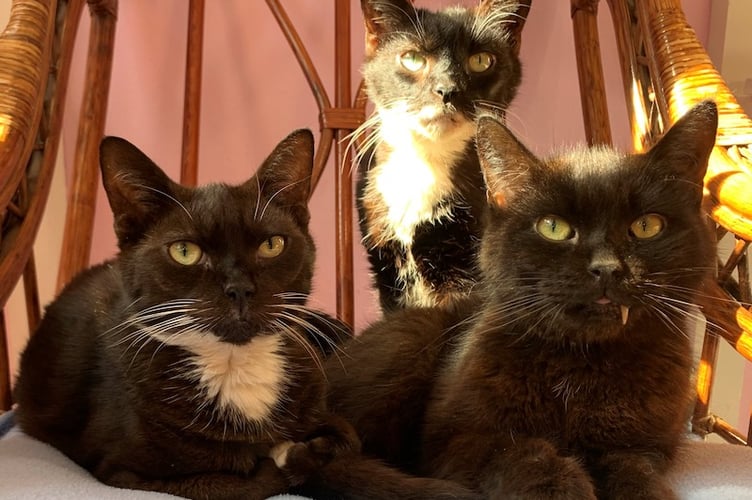
You can pretty much guarantee that we will have a black cat in our cattery looking for a new home all year round, and this week we have not one but three black beauties to tell you about: Brie, Gouda (both female) and Monterey Jack (a male, otherwise known as ’MJ’). They are all about 10 years old and their previous owner’s personal circumstances left him unable to care for them properly.
They were flea-ridden and grubby when they arrived in the cattery, but they’ve responded well to some TLC and they are ready to go to their new home - ideally all together.
The cattery team call them the ’mature cheeses’ and they are very fond of the trio, not least because they are all so easy-going and affectionate.
Brie, in particular, rolls over for a belly rub at the slightest opportunity and Gouda has a deafening purr.
Although we don’t want to perpetuate the association of black cats with Satanism, we do need to draw your attention to MJ’s fang which you can just about see in the photograph.
It makes his face look comical, rather than frightening, and simply adds to his character.
The ’mature cheeses’ are very bonded and are delightful to observe, as they groom and play with each other. They will be a fantastic addition to a home and, who knows, may bring a triple dose of good luck to their new owners!
Comments
This article has no comments yet. Be the first to leave a comment.