
As the end of October approaches, many people will be planning to celebrate Hop-tu-Naa, which is thought to be the oldest unbroken tradition in the Isle of Man.
As we say good-bye to summer and welcome in winter, Hop-tu-Naa will be mixed in with a celebration of Halloween.
Witches feature in both of the traditions, with our famous Manx one being, of course, Jinnie the Witch.
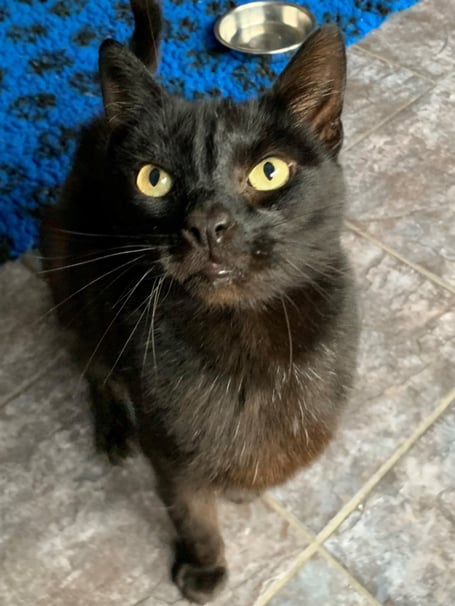
And so it is fitting that this week we should celebrate the black cat.


-(2).jpeg?width=209&height=140&crop=209:145,smart&quality=75)
.jpeg?width=209&height=140&crop=209:145,smart&quality=75)
Cats have been associated with witches for hundreds of years.
Black cats in the middle ages were believed to be witches’ familiars, and some people even believed them to be witches incarnate.
Many of these old superstitions about black cats exist to this day, and we think this is the main reason why our black cats take longer to be adopted than those of other colours.
However, in many countries black cats are seen as a good luck charm or a good omen - a black cat appearing on your doorstep signals prosperity (a common belief in Scotland), and a black cat crossing your path signals good fortune (in England and Ireland).
Another reason given for black cats being overlooked when it comes to adoption is that they are difficult to photograph, but a shiny black cat can be very photogenic.
In fact, most black cats are not completely black, and they can have feint stripes or speckles in their coats.
They also change colour in the sun - ’rusting’ is where, in bright sunlight, a black cat can appear to be a reddish-brown colour.
A black cat is also likely to be healthier than its counterparts.
Research has shown that the genetic mutations that causes cats to have black coats may offer them some protection from diseases such as cancer and the feline equivalent of Alzheimer’s.
You can pretty much guarantee that we will have a black cat in our cattery looking for a new home all year round, and it’s Avon who finds himself in this position at the moment.
He is 10 years old, and has been a loving family pet all his life.
But he started to become very stressed by his circumstances - in particular the other cats in his household, and a barking dog next door.
Avon’s stress manifests itself in over grooming, and he came to us with large bald patches on his back and legs - basically anywhere he could reach to lick and lick, and lick.
We have treated his wounds and reduced his levels of stress, and so he’s on the mend and ready to go to a new home.
He is a very affectionate lap cat, and enjoys being inside but needs to be able to go outside as well.
Ideally his new owner will be an experienced cat person, perhaps someone who will use the ’slow blink’ technique to befriend him, and make him feel at home.
The University of Sussex has recently undertaken research to demonstrate that blinking slowly at a cat is a form of positive communication.
They tested 45 cats who were more likely to approach the outstretched hand of a stranger after that person had slow blinked, compared with when they had maintained a neutral expression.
Slow blinking is a great way to enhance the bond you have with your cat.
Try narrowing your eyes at them as you would in a relaxed smile, followed by closing your eyes for a couple of seconds.
You’ll probably find that they respond in the same way, and mirror what you’re doing, and then you can have a ’feline conversation’ together.
Comments
This article has no comments yet. Be the first to leave a comment.