
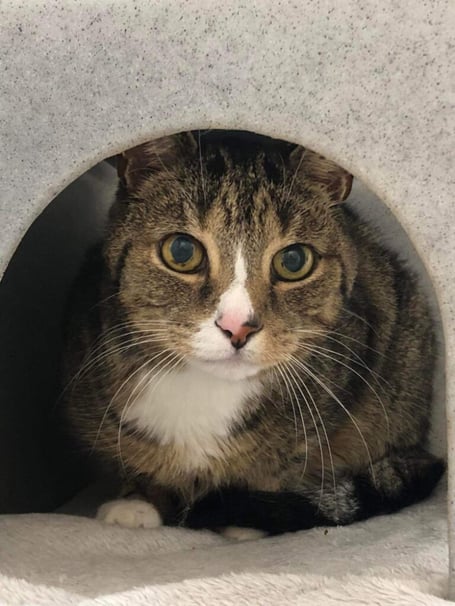
Did you know that cat meditation is ’a thing’? It really is!
We’ve seen fitness gurus come and go over the years, and wellbeing trends fall in and out of fashion, but could cat meditation be here to stay?
In fact, have we been doing it for millennia without even realising?
Cats live in the moment and they can often have a soothing influence on the people around them; and simply stroking a cat can be a therapeutic exercise for many people.

.jpg?width=209&height=140&crop=209:145,smart&quality=75)
Cats apparently have more nerve cells than humans in a part of their cerebral cortex that emits a higher degree of alpha waves.
Alpha waves are associated with relaxation and contemplation, which is probably why cats can spend up to 80% of their time sleeping.
Observing a sleeping cat can be a way to de-stress and become more mindful, and all you need is a comfy chair and an obliging feline friend. Here are the steps to follow:
-Begin by looking at your sleeping cat and noticing their posture, quietness and contentment.
-Observe their slow, gentle breathing.
- Lower your gaze.
-Bring your awareness to your breath, noticing the rhythm of breathing in and out. Then breath in and out for a count of three or four, maybe even try to mirror the slow breathing of your cat.
-Now become aware of your body as a whole and how it feels - hot or cold, heavy or light, or any other sensations.
-Now move through each part of your body in turn, paying special attention to the way each area feels. Start with your feet and toes, then gradually move up your body in stages until you reach the top of your head.
-Then, when you are ready, gradually come back to the sounds of the room and take a moment to observe your sleeping cat, and enjoy your renewed sense of calmness and relaxation.
Handsome ten-year-old Ikaris would be an ideal meditation companion.
He’s very friendly and enjoys human company - albeit on his terms.
He likes to be near people but he doesn’t enjoy being picked up because he has a titanium hip.
He had a road traffic accident as a kitten and his previous owner spent several thousand pounds on surgery, avoiding the need for Ikaris to have his leg amputated.
He has full movement and can jump and run like any other cat, but he is clearly quite sensitive around his hip area.
His previous owner developed serious health issues and has a compromised immune system, and so his doctor has recommended that he no longer has pets. He was heart-broken when he brought Ikaris to us for rehoming, but we have assured him that we will find Ikaris a wonderful new home where he will be the centre of attention.
Ikaris doesn’t seem to like other cats and we think he would be happiest in a home with no other pets and where his human companions are mature enough to understand his likes and dislikes.
He has a big personality and he will bring a great deal of pleasure to his new owners.
We don’t have many cats in our main cattery at the moment, but we have had quite a few feral cats in our isolation unit as part of our trap, neuter and return (TNR) scheme.
Luckily all of these ferals are being welcomed back to their original locations, in particular a local fish farm where the help they provide with rodent control is much appreciated.
If you would like to ’house a mouser’ then please let the cattery team know (by contacting [email protected]; or calling 851672, option two), and when we have feral cats that can’t be returned to their original location we can contact you.
Comments
This article has no comments yet. Be the first to leave a comment.